What PRP is and why it is used for knee pain
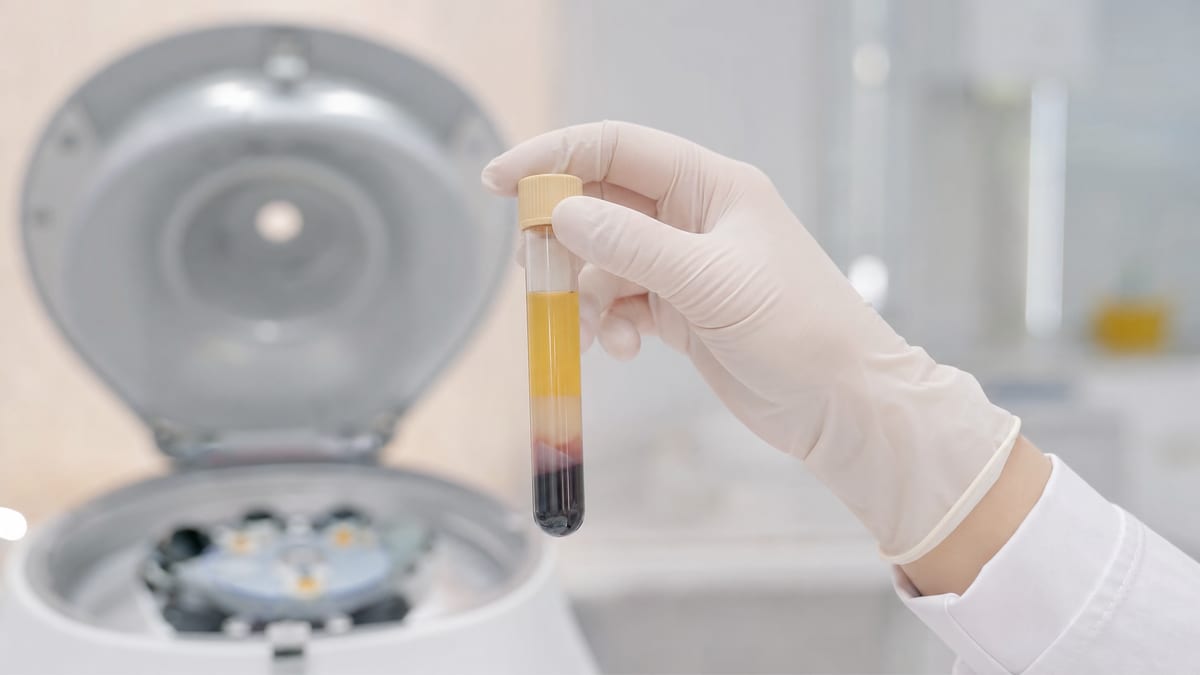
Platelet rich plasma, or PRP, is prepared from a small sample of your own blood. A nurse or doctor draws around 15 to 60 millilitres, depending on the treatment area, and spins it in a centrifuge. This separates the blood into layers, and the layer richest in platelets, along with the growth factors and signalling proteins they carry, is drawn off and injected back into the joint. Because the material comes from your own body, there is no risk of the immune reaction or rejection that can accompany donor tissue or synthetic injectables.
For the knee specifically, the rationale is that platelets play a central role in how the body repairs soft tissue and manages local inflammation. Knee osteoarthritis involves progressive breakdown of cartilage, low grade inflammation within the joint, and pain that limits movement. By concentrating platelets and delivering them directly into the joint space, PRP aims to calm that inflammatory environment and support the tissue that remains, rather than simply masking pain the way a painkiller or steroid injection does.
PRP for knee pain has moved from a niche sports medicine treatment into a mainstream option offered by orthopaedic specialists, sports medicine clinics and some GPs across Ireland. Part of that shift reflects a genuinely maturing evidence base. Unlike some regenerative treatments where the research is still mostly in animals or small uncontrolled studies, PRP for knee osteoarthritis now has multiple large meta-analyses of randomised controlled trials behind it, which is why it is treated more cautiously as one option to weigh rather than dismissed or oversold.
How much does PRP for knee pain cost in Ireland in 2026?
PRP for musculoskeletal conditions such as knee osteoarthritis generally costs more than PRP for skin or hair, because it typically involves a specialist practitioner, ultrasound guidance to place the injection accurately within the joint, and a higher standard of clinical governance. In Ireland, a single PRP knee injection typically costs between EUR 500 and EUR 1,200, depending on the clinic, the practitioner's specialism and whether ultrasound guidance is included as standard.
Most practitioners recommend a course rather than a single injection. Based on the current evidence on injection frequency, discussed in more detail below, three to five injections spaced one to two weeks apart is a common protocol, though some clinics use a more spaced out schedule of three sessions over several months. A full course therefore typically costs somewhere between EUR 1,500 and EUR 5,000, with the wide range reflecting differences in the number of injections, the platelet concentration technology used, and whether imaging guidance is included in the price.
On top of the injections themselves, expect a consultation fee in the region of EUR 50 to EUR 150 for the initial assessment, which may include a physical examination and sometimes imaging such as an X-ray or ultrasound of the joint if you do not already have recent scans. Some clinics fold this into the cost of the first session, others charge separately, so it is worth asking for a full breakdown before you commit. Prices last checked in September 2026 and can change, so always confirm current pricing directly with a clinic before booking.
What the evidence actually shows for knee osteoarthritis
The strongest evidence available for PRP in knee osteoarthritis comes from two meta-analyses published in 2025. The first, by Bensa and colleagues in the American Journal of Sports Medicine, pooled 18 randomised controlled trials covering 1,995 patients comparing PRP against a placebo injection. Using the minimal clinically important difference as the benchmark, meaning the smallest improvement a patient would actually notice in daily life, PRP produced pain and function improvements that exceeded this threshold at three, six and twelve month follow up points for function, and at three and six months for pain specifically.
The second, a systematic review and meta-analysis by Wang and Yao in the European Journal of Medical Research, pooled 28 randomised controlled trials covering 3,246 knee osteoarthritis patients. It found PRP delivered pain relief comparable to hyaluronic acid injections but with superior functional improvement, particularly when the two were combined. Compared with corticosteroid injections, PRP alone showed no significant difference in efficacy, but outcomes improved when PRP was combined with a corticosteroid. PRP also outperformed physical therapy and exercise alone on both pain and function measures.
Taken together, this is a genuinely encouraging picture for a treatment that a decade ago rested mostly on small, uncontrolled studies. It is one randomised trial evidence base now, not a single trial, and multiple independent meta-analyses reach broadly consistent conclusions. That said, the improvements, while real and clinically meaningful by the studies' own benchmarks, are moderate rather than dramatic, and PRP works better for people with earlier stage osteoarthritis than for those with severe, advanced joint damage.
Why platelet concentration and injection protocol matter
One of the most useful findings from the 2025 evidence is that not all PRP is equal. The Bensa meta-analysis found that high platelet concentration PRP, defined using a cutoff of roughly one million platelets per microlitre, produced clinically significant pain relief that persisted through 12 months, while low platelet concentration PRP failed to produce a perceivable benefit on the pain scale used and lost statistical significance against placebo by 12 months on the function measure. In other words, a poorly prepared PRP injection may do very little, even though the underlying concept is sound.
The Wang and Yao review separately identified an optimal platelet concentration range of roughly 600 to 900 times ten to the ninth per litre, with three to five injections spaced seven to fourteen days apart yielding the best outcomes, and earlier intervention in mild to moderate osteoarthritis outperforming treatment started once damage is more advanced. This is a useful, practical takeaway for anyone considering PRP in Ireland: the centrifuge system, the preparation protocol and the number and spacing of injections are not just administrative details, they are variables the evidence links directly to whether you are likely to benefit.
In practice, this means it is entirely reasonable to ask a prospective clinic what system they use to prepare PRP, roughly what platelet concentration it achieves, and how many sessions they recommend and why. A clinic that cannot answer these questions, or that offers a single injection with no clear rationale for the protocol, is not necessarily following the approach the evidence actually supports.
PRP versus other knee osteoarthritis treatments
PRP sits within a wider set of options for knee osteoarthritis, and it is worth understanding where it fits. Corticosteroid injections act faster and cost less per injection, and remain useful for short term flare ups, but their benefit tends to fade within weeks to a few months, and repeated steroid injections carry a theoretical risk of accelerating cartilage loss with frequent long term use. Hyaluronic acid injections, sometimes called viscosupplementation, aim to improve joint lubrication and have a more mixed evidence base than PRP, with some trials showing modest benefit and others showing little difference from placebo.
Physiotherapy and structured exercise programmes remain a foundation of osteoarthritis management regardless of whether someone also has PRP, and the evidence base for exercise in reducing pain and improving function in knee osteoarthritis is itself strong. The 2025 evidence discussed above found PRP outperformed physical therapy and exercise alone on both pain and function, but this does not mean exercise should be dropped. Most specialists recommend PRP as an addition to, rather than a replacement for, an ongoing exercise and strengthening programme.
For advanced, bone on bone osteoarthritis, surgical options such as partial or total knee replacement remain the standard route to restoring function in that situation, and PRP is not positioned as an alternative to surgery at that stage. Where PRP has its clearest role is in mild to moderate osteoarthritis, in people who want to delay or reduce their reliance on other interventions, or who have not responded well to more conservative measures such as physiotherapy, weight management and anti-inflammatory medication.
What a PRP knee injection appointment involves
A typical PRP appointment for the knee takes around 45 minutes to an hour from start to finish. The process begins with a blood draw from a vein in your arm, similar to a routine blood test, which takes only a couple of minutes. That sample is then placed in a centrifuge and spun for roughly 10 to 15 minutes to separate the platelet rich layer from the rest of the blood.
While the sample is processing, the clinician will typically clean the knee and may apply a local anaesthetic to the skin over the injection site, though the joint itself is not usually numbed internally in the way a dental procedure would be. Many practitioners use ultrasound guidance to visualise the joint space in real time and ensure the PRP is delivered precisely where it is needed, rather than into surrounding soft tissue. The injection itself typically takes only a few minutes.
Afterwards, most people can walk out and resume light activity the same day, though practitioners generally advise avoiding strenuous exercise, heavy lifting and high impact sport for around 48 hours. Some swelling, stiffness or mild discomfort in the joint for a day or two afterwards is common and expected, as the injection itself provokes a controlled inflammatory response that is part of how PRP is thought to work. Over the counter anti-inflammatory painkillers are sometimes discouraged in the days immediately around treatment, since they may blunt the inflammatory signalling PRP relies on, so it is worth asking your practitioner what pain relief they recommend instead.
Regulation, safety and who should avoid PRP
Because PRP is prepared from your own blood and returned to your own body, it does not require the same regulatory pathway as a pharmaceutical product overseen by the Health Products Regulatory Authority. It is, however, a medical procedure involving a blood draw and an injection into a joint, and the Medical Council of Ireland requires that any doctor performing this kind of procedure be registered and practising within their competence. Before booking, it is reasonable and sensible to check a practitioner's registration using the Medical Council's public register.
Safety wise, the autologous nature of PRP means the risk of allergic reaction or immune rejection is low compared with synthetic injectables or donor tissue. The main risks relate to the injection itself: bruising, swelling, infection at the injection site, and a temporary flare of pain in the days afterwards as the joint responds to the treatment. Serious complications are uncommon when PRP is administered by a suitably trained, registered practitioner using sterile technique.
PRP is not appropriate for everyone. People with certain blood disorders, active infections, some cancers, or those taking specific blood thinning medications may need to avoid PRP or discuss it carefully with their doctor first. It should also not be treated as a way to avoid seeing a doctor about worsening knee pain, since ruling out other causes and confirming the stage of osteoarthritis through examination and imaging is an important part of deciding whether PRP is a sensible option in the first place.
How to choose a PRP provider in Ireland
Given how much the evidence links outcomes to platelet concentration and protocol, choosing a provider on the basis of technique and transparency matters more than choosing on price alone. Start by confirming the practitioner is registered with the Medical Council of Ireland, which is non negotiable for any procedure involving a blood draw and injection. From there, ask what PRP preparation system the clinic uses, roughly what platelet concentration it achieves, and how many sessions they recommend for your specific level of osteoarthritis and why.
It is also worth asking whether the injection is given under ultrasound guidance, since accurate placement within the joint space is part of what the evidence supporting PRP is actually based on. A clinic that is confident in its process should be able to answer these questions clearly and without hesitation, and should give you a full breakdown of costs, including the consultation, each injection and any imaging, before you commit to a course.
Gerovia's directory lists PRP providers across Ireland, including orthopaedic and sports medicine focused clinics in Dublin, Cork and the Midlands that specialise in joint injections, alongside clinics in Galway and Limerick. Comparing a small number of providers on their protocol, their registration status and their transparency on pricing, rather than on headline price alone, is the approach the evidence supports.