Why Belfast and Northern Ireland for HBOT
Belfast has quietly become one of the more accessible places on the island of Ireland to try hyperbaric oxygen therapy. Over the past few years, a mix of dedicated HBOT studios, multi-treatment longevity clinics and long-established charity-run oxygen centres have made it possible to access chamber sessions without the waiting lists or premium pricing that can mark the market further south. For anyone in Belfast, the greater Belfast area, or anywhere in Northern Ireland, the options are more varied than many people realise.
The appeal is partly practical and partly financial. Northern Ireland's HBOT providers tend to price sessions in sterling at rates that are meaningfully lower than their counterparts in the Republic, where a single session commonly costs €100 to €150. In NI, the typical range sits between £28 and £45 per session depending on the provider and whether you buy a package, making it one of the more affordable places in the British Isles to explore hyperbaric therapy. For border-county residents or anyone willing to make the journey, that price difference alone can be significant over a full course of treatment.
Beyond the cost, Northern Ireland benefits from a distinctive mix of provider types. You will find everything from purpose-built HBOT facilities in the greater Belfast area, to city-centre longevity clinics that offer hyperbaric therapy alongside other modalities like cryotherapy and red light therapy, to charity-run MS oxygen therapy centres that have been operating for decades. Each serves a slightly different clientele and comes with its own strengths, which this guide will help you navigate.
What hyperbaric oxygen therapy involves
Hyperbaric oxygen therapy works on a straightforward principle: by placing you in a pressurised chamber and having you breathe oxygen at higher-than-normal atmospheric pressure, your lungs absorb significantly more oxygen than they can at sea level. That oxygen dissolves into your blood plasma at elevated concentrations, reaching tissues throughout the body and, in theory, supporting healing, reducing inflammation and aiding cellular repair.
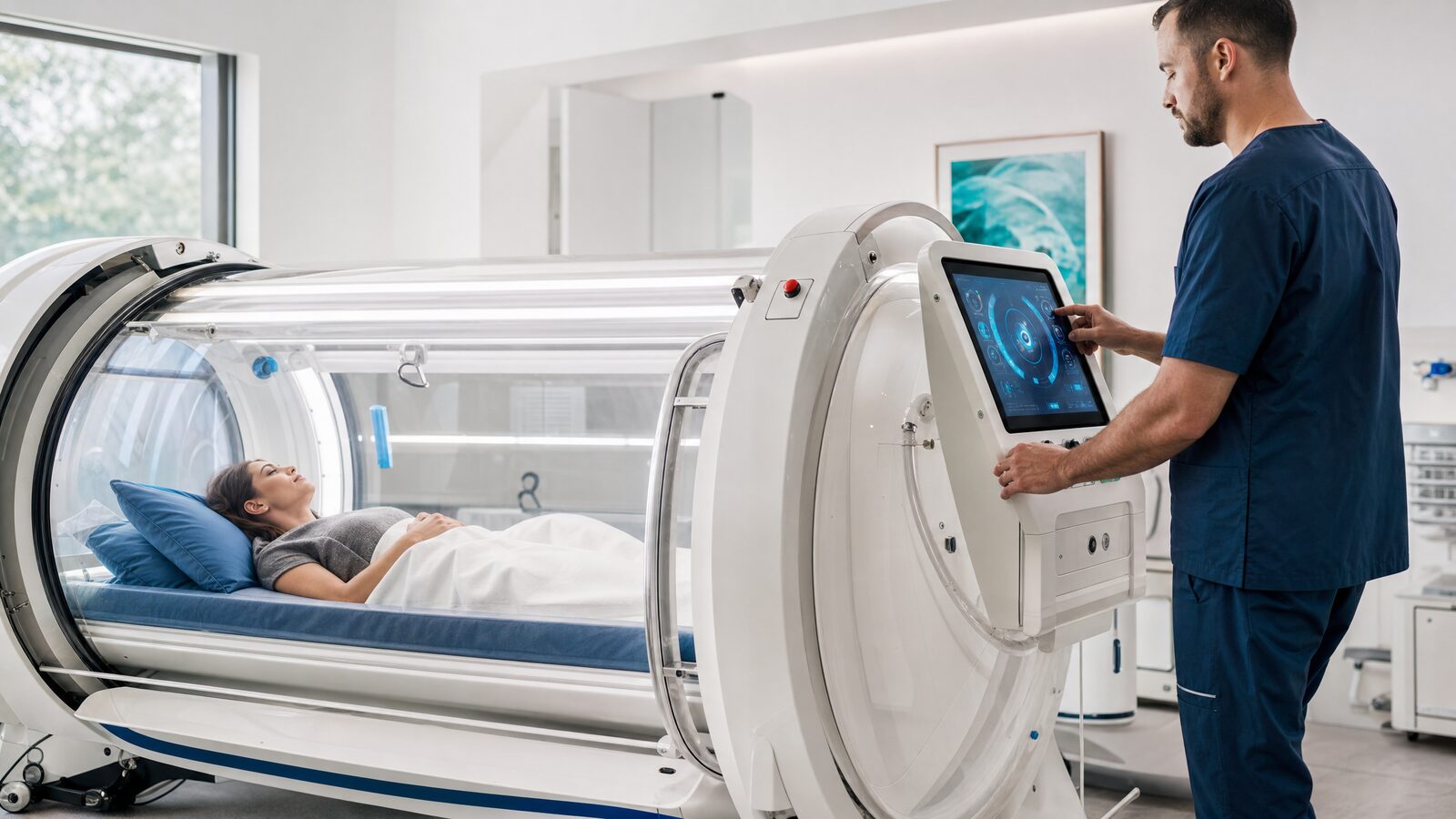
The sessions themselves are generally relaxed. You enter the chamber, which is then gradually pressurised over a few minutes. During this phase you may feel pressure in your ears, much as you would during take-off on a flight, and the operator will guide you through simple equalisation techniques. Once at pressure, you simply breathe normally for the duration of the session, which typically lasts between sixty and ninety minutes. Many people read, listen to podcasts or simply rest. Afterwards, the chamber is slowly depressurised and you carry on with your day. There is no recovery period required.
It is worth understanding the distinction between the two broad categories of HBOT you will encounter. Wellness or mild HBOT, which is what the private clinics and studios in Northern Ireland offer, operates at pressures of around 1.3 to 1.5 ATA (atmospheres absolute). Medical HBOT, used in hospital settings for conditions like decompression sickness, carbon monoxide poisoning and certain non-healing wounds, runs at significantly higher pressures of 2.0 to 2.8 ATA. These are genuinely different treatments with different evidence bases, and keeping that distinction clear will help you set appropriate expectations.
HBOT providers across Belfast and Northern Ireland
The HBOT landscape in Northern Ireland can be broadly divided into three types of provider, each with a different character and price point. Understanding these categories will help you find the right fit for your needs and budget.
The first category is dedicated HBOT studios, typically smaller operations focused primarily or exclusively on hyperbaric therapy. In the greater Belfast area, there are providers operating out of fitness and wellness complexes in suburbs like Newtownabbey, offering affordable per-session rates and multi-session packages. These tend to be accessible, no-frills environments where the focus is squarely on getting you into the chamber efficiently and affordably. They are often a good starting point if you want to try HBOT without a large upfront commitment, and their package deals can bring the cost per session down to very competitive levels.
The second category is the multi-modality longevity clinic. Belfast city centre is home to at least one premium clinic that positions HBOT as part of a broader suite of longevity and recovery treatments, alongside services like cryotherapy, red light therapy and infrared sauna. If you are interested in combining HBOT with other modalities in a single visit, or if you prefer a more clinical, city-centre setting, this type of provider may suit you better. The pricing tends to reflect the premium setting and broader offering.
The third and often overlooked category is the charity-run oxygen therapy centre. Northern Ireland has several of these, originally established to serve people with multiple sclerosis. The longest-running centre has been operating since the late 1980s and is located in Newry, whilst others serve the north-west of the province. These centres welcome self-referrals and often treat a wider range of conditions than their original MS focus might suggest. Because they operate on a charitable basis, their pricing structures can be very accessible, though availability may vary and their primary commitment remains to people with MS and related conditions.
How much does HBOT cost in Northern Ireland
One of the most attractive aspects of HBOT in Northern Ireland is the pricing. Single sessions at private wellness providers typically fall in the range of £35 to £45, with some offering a slightly higher introductory rate for a first visit that includes an orientation to the chamber and the process. This is a fraction of what you might pay in Dublin or other Republic of Ireland locations, where €100 to €150 per single session is the norm.
The real value, as with most HBOT providers anywhere, lies in buying a multi-session package. Courses of five sessions are commonly available in the region of £140 to £160, bringing the per-session cost to around £28 to £32. Ten-session packages typically fall in the £250 to £300 range, with some providers bringing the effective rate down to under £30 per visit. For anyone planning a sustained programme, and HBOT is almost always recommended as a course rather than a one-off, these packages represent a meaningful saving over paying session by session.
It is worth noting that the price comparison with the Republic of Ireland is particularly striking when you factor in the exchange rate. Even at the top end of NI pricing, a session at £45 translates to roughly €52 or €53 at current rates, which is still well below half the typical Dublin single-session price. For anyone living in border counties like Monaghan, Louth, Cavan or Donegal, the savings from travelling north for HBOT can be substantial, especially over a ten or twenty-session course. Just remember to factor in your travel costs and time when making that calculation.
What conditions and goals bring people to HBOT in Belfast
The people walking through the doors of Belfast-area HBOT providers come with a wide range of goals and conditions. Sports recovery is one of the most common drivers, with athletes and regular gym-goers using hyperbaric sessions to support muscle repair and reduce post-training inflammation. The greater Belfast fitness community has embraced HBOT partly because several providers are co-located with gyms and fitness facilities, making it easy to combine a training session with chamber time.
Beyond sports, chronic fatigue and post-viral recovery, including long COVID, have brought a new wave of interest in hyperbaric therapy across Northern Ireland. Many people report improvements in energy, cognitive clarity and general wellbeing after a course of sessions, though it is important to be honest that the scientific evidence for these benefits remains mixed and is still developing. Wound healing, particularly for slow-healing injuries or post-surgical recovery, is another area where people seek out HBOT, as is general wellness and what might loosely be called anti-ageing or longevity support.
The charity-run oxygen therapy centres see a somewhat different population, with their primary focus on multiple sclerosis and other neurological conditions. MS patients in Northern Ireland have had access to oxygen therapy through these centres for nearly four decades, and many report that regular sessions help manage symptoms such as fatigue, bladder issues and cognitive difficulties. These centres also increasingly welcome people with other conditions, though their charitable mission and MS focus rightly take priority. If you are considering one of these centres for a non-MS condition, it is courteous and practical to enquire about availability before assuming you can book in.
Safety, regulation and choosing a provider
HBOT is generally considered safe when administered properly, but it is not without risks and it is not suitable for everyone. People with certain lung conditions, recent ear or sinus surgery, a history of pneumothorax, claustrophobia or some cardiac issues should either avoid HBOT or be assessed carefully before entering a chamber. A responsible provider will always take a thorough medical history and screen for contraindications before your first session. If a provider shows no interest in your health background and simply wants to sell you chamber time, treat that as a significant red flag.
It is worth being aware that wellness HBOT in Northern Ireland, as in the rest of the United Kingdom and Ireland, is not subject to specific statutory regulation. There is no licensing body that certifies HBOT wellness clinics, and the sector operates largely on a self-regulated basis. This does not mean that the providers are unsafe, but it does mean that the onus falls on you to ask the right questions. Enquire about the operator's training and qualifications, the maintenance schedule for the chamber, the emergency protocols in place and the maximum pressure the chamber operates at. A confident, well-run operation will answer these questions openly.
The distinction between wellness HBOT and medical HBOT also matters here. If you have a condition that falls within the established medical indications for hyperbaric therapy, such as decompression sickness, carbon monoxide poisoning, gas gangrene or certain non-healing diabetic wounds, the appropriate route is through the hospital system rather than a private wellness clinic. Medical HBOT is delivered at significantly higher pressures under close clinical supervision, and accessing it through the proper medical pathway ensures you receive the right standard of care. Your GP can advise on whether a medical referral is appropriate for your situation.
NHS and insurance coverage for HBOT in Northern Ireland
The question of whether the NHS or private health insurance will cover your HBOT sessions is one that comes up frequently, and the answer for most people is straightforward: they will not. The NHS provides medical HBOT through specialist hospital units for a narrow list of approved conditions, but this is accessed via clinical referral and is an entirely different pathway from walking into a private wellness clinic. If your GP or consultant believes you have a condition that warrants medical HBOT, they can refer you accordingly, but this is a clinical decision, not a consumer one.
For the wellness uses that bring most people to private HBOT providers, including recovery, energy, general wellbeing, sports performance and longevity, the cost falls entirely on you. Private health insurers operating in Northern Ireland do not, as a rule, reimburse HBOT sessions taken for these purposes. They are treated as elective wellness spending in the same category as gym memberships or spa treatments. This is unlikely to change until the evidence base for wellness HBOT strengthens considerably.
Given that you will be paying out of pocket, it is important to budget realistically. A single curiosity session at £35 to £45 is a modest outlay, but a full course of ten to twenty sessions, which is what most providers recommend for meaningful results, represents a commitment of roughly £250 to £600 or more. Before signing up for a large package, consider whether this is money you can comfortably spend on something where the outcomes are hopeful rather than certain, and whether the fundamentals of good health, including sleep, nutrition, exercise and stress management, are already well covered in your routine.
Getting started with HBOT in Belfast
If you have decided to explore hyperbaric oxygen therapy in the Belfast area, a sensible first step is to book a single introductory session rather than committing to a large package straight away. Most providers offer a first-visit option that includes an orientation to the chamber, a brief health screening and your initial session, giving you a chance to experience the process and see how you respond before investing further. Pay attention to how the provider communicates, how thoroughly they screen your health history, and how comfortable you feel in the chamber itself.
Practically speaking, you should wear comfortable, loose-fitting clothing to your session. Most providers will ask you to remove electronic devices, jewellery and anything that could be affected by changes in pressure. Sessions typically last sixty to ninety minutes at pressure, plus a few minutes either side for pressurisation and depressurisation, so allow around ninety minutes to two hours for the whole visit including any paperwork and changing time. There is no downtime afterwards, and most people go straight back to their normal activities.
If you are travelling from outside Belfast, it is worth noting that NI's HBOT providers are spread across the region rather than concentrated in the city centre. Some of the most affordable options are in suburban areas to the north of Belfast, while the premium multi-modality clinics tend to be in the city centre itself. The charity-run centres are further afield, in Newry and the north-west. Plan your journey accordingly, and if you are coming from the Republic, remember that while the border is invisible, the currency changes and you will be paying in sterling. You can browse HBOT and other longevity providers across Northern Ireland and the Republic in the Gerovia directory to compare your options before booking.