What the newest evidence actually shows
For years, the honest answer to "does cryotherapy speed up recovery" has been a shrug: probably something, for some people, under some conditions. A systematic review and network meta-analysis published in Frontiers in Sports and Active Living in April 2026 gives Irish athletes something more precise to work with. The researchers pooled 51 randomised controlled trials covering 1,243 participants and compared four cold-exposure methods head to head: whole-body cryotherapy (standing in a chamber cooled to around minus 110C to minus 140C), cold water immersion, contrast water therapy, and local cold therapy applied to a specific muscle group.
The headline finding is that cryotherapy's effect on recovery is not a single, flat benefit. It changes shape depending on how long ago you exercised and what you are actually measuring. Immediately after exercise, none of the four modalities significantly reduced delayed-onset muscle soreness (DOMS) compared with doing nothing. That alone contradicts a common assumption that jumping into a cryo chamber straight after a session has an instant soreness-relieving effect.
Where cryotherapy does show a measurable, evidence-backed benefit is further down the recovery timeline. Cold water immersion produced the biggest reduction in soreness at one hour and 24 hours after exercise. Local cold therapy produced the largest soreness reduction at 48 hours. Whole-body cryotherapy, meanwhile, pulled ahead specifically on markers of muscle damage, producing the largest drop in creatine kinase, a blood marker of muscle cell damage, at both 48 and 72 hours, and the most sustained improvement in countermovement jump performance (a standard test of explosive leg power) out to 72 hours.
Whole-body cryotherapy, cold water immersion, and local cold: what's the difference
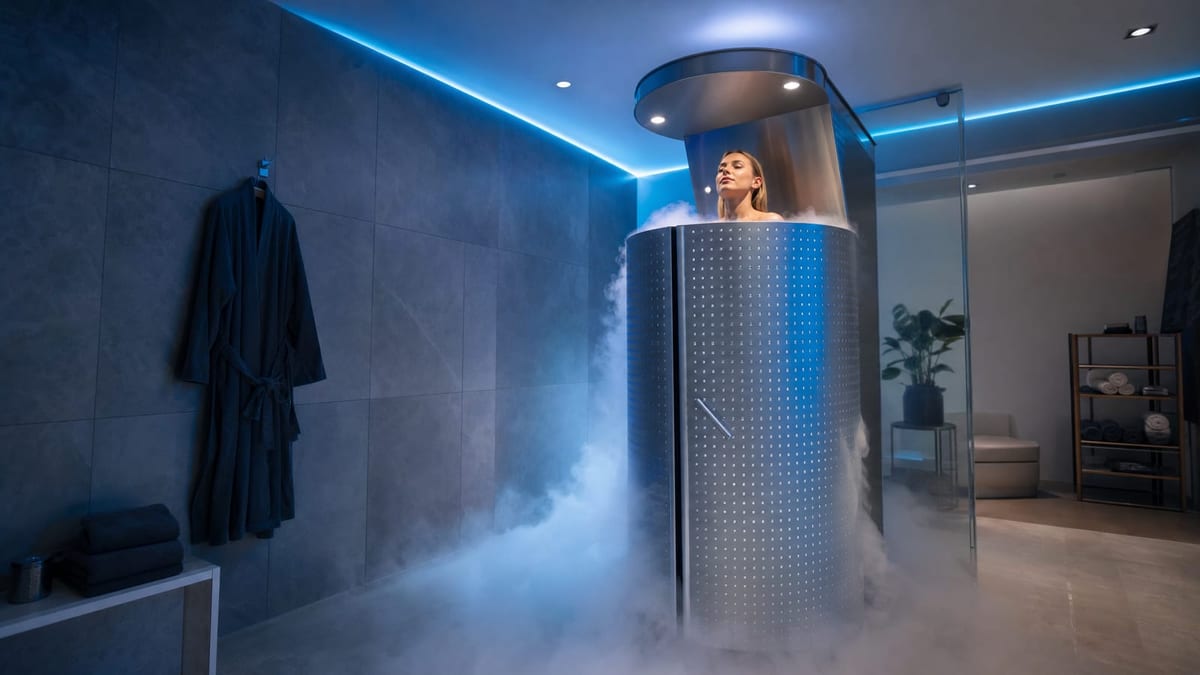
These terms get used loosely, so it is worth being precise about what each one actually involves, because the 2026 meta-analysis found they do not behave identically. Whole-body cryotherapy (WBC) places the whole body, head usually excluded, into an enclosed chamber cooled by refrigerated air or vaporised liquid nitrogen for roughly two to three minutes. It is the modality offered at most dedicated Irish wellness and recovery clinics.
Cold water immersion (CWI), often called an ice bath, submerges the body in water typically between 10C and 15C for anywhere from five to twenty minutes. It is cheaper to set up than a cryotherapy chamber and is widely used by Irish sports clubs and GAA, rugby, and athletics squads using nothing more than a plastic tub and bags of ice.
Contrast water therapy alternates between warm and cold water immersion, intended to create a pumping effect in blood vessels, while local cold therapy targets a single joint or muscle group with an ice pack, cold gel, or localised cryotherapy device rather than cooling the whole body. The 2026 trial data suggests these are not interchangeable: each modality has a different time-course and a different outcome it is best at, so which one an athlete reaches for should depend on what they are trying to achieve and when.
What a whole-body cryotherapy session actually feels like
For anyone considering trying it for the first time, the experience is brief and startling rather than painful. Clients change into minimal, dry clothing (gloves, socks, and slippers are standard, to protect extremities from frostbite) and step into a chamber for two to three minutes at temperatures between minus 110C and minus 140C. Staff monitor the session throughout and the door is never locked.
The cold is dry, which makes it more tolerable than it sounds; most first-time clients describe the final thirty seconds as the most intense part, followed by a rush of warmth and alertness once they step out. Sessions at reputable Irish clinics are always supervised by trained staff, and a pre-session health screening is standard practice to rule out contraindications.
Localised cryotherapy, by contrast, targets a specific joint, such as a knee or shoulder, with a handheld device blowing cold air directly onto the area for several minutes. It is generally more comfortable, cheaper, and better suited to treating a single injury site rather than whole-body recovery after a hard training session.
Where the evidence is thinner than the marketing suggests
It is worth holding the 2026 network meta-analysis alongside an earlier, smaller systematic review published in the Journal of Clinical Medicine in 2022. That review pooled six trials and 120 participants comparing whole-body and partial-body cryotherapy and found the two modalities produced similar effects on muscle performance, soreness, and muscle damage markers, with no meaningful difference between them. The studies included were rated as moderate quality on a standard methodology scale, averaging 4.3 out of 10.
The two reviews are not contradictory so much as they operate at different levels of precision. The larger, more recent network meta-analysis can detect time-specific differences between modalities because it pools far more trials and participants. The smaller 2022 review, working with a fraction of the data, could only conclude that whole-body and partial-body cryotherapy are broadly similar to each other, without the statistical power to detect the finer time-course differences the 2026 analysis found.
The practical lesson for athletes and clinics in Ireland is that this is a genuinely active area of sports science, where the answer has sharpened considerably with more data, but individual trials still tend to be small, and no single study should be treated as the final word. The 2026 findings are a systematic review and network meta-analysis, the strongest form of evidence this field currently has, and they are the most reliable guide available, but recovery science continues to evolve.
What cryotherapy does not do
Despite how it is sometimes marketed, cryotherapy is not a treatment for weight loss, and there is no trial evidence showing whole-body cold exposure burns a clinically meaningful number of calories or produces lasting fat loss. Claims that cryotherapy "detoxifies" the body also have no basis in the research; the body does not accumulate toxins that a cold chamber flushes out, and the liver and kidneys already handle that role continuously.
It is equally important to be clear about the DOMS finding from the 2026 meta-analysis: no cryotherapy modality reduced soreness in the immediate aftermath of exercise. Athletes expecting a cryo session straight after a match to make them feel instantly less sore should recalibrate that expectation; the soreness-reducing effect, where it exists, shows up later, at the 24- to 48-hour mark, and depends on which modality is used.
Cryotherapy is also not a substitute for the fundamentals of recovery: adequate sleep, protein and carbohydrate intake, and a sensible training load remain the biggest levers an athlete has. Cold exposure is a supplementary tool that can meaningfully speed specific markers of recovery, not a replacement for the basics.
Who should avoid it and what the safety considerations are
Whole-body cryotherapy is not suitable for everyone. People with uncontrolled high blood pressure, heart arrhythmias, or other significant cardiovascular conditions should avoid it, because the extreme cold triggers a rapid vasoconstriction response that places a brief but real strain on the cardiovascular system. People with Raynaud's disease, a condition causing exaggerated vasospasm in response to cold, are also advised against it, as are pregnant women and anyone with an open wound or active skin infection.
Reputable Irish clinics screen new clients with a health questionnaire before the first session and will decline to treat anyone presenting a contraindication. Sessions should always be supervised, with a maximum time limit enforced by staff rather than left to the client's own tolerance, since the cold can mask the sensation of frostbite risk to extremities.
If you take prescribed medication for a heart condition, high blood pressure, or a clotting disorder, speak to your GP before trying whole-body cryotherapy, and mention any relevant medical history to clinic staff during the screening.
What cryotherapy costs in Ireland
Prices across Irish cryotherapy providers are fairly consistent. A single whole-body cryotherapy session typically costs between €50 and €100, with most clinics in Dublin, Cork, Galway, and other cities sitting in the middle of that range. Buying a package of five to ten sessions is the norm for athletes using it regularly through a season, and this usually brings the effective per-session price down to somewhere between €40 and €60.
Localised cryotherapy, aimed at a single joint or injury site rather than the whole body, is cheaper again, generally €30 to €60 per session, reflecting the shorter equipment setup and smaller treatment area involved.
These figures were last checked in October 2026 and can vary by clinic, chamber type (electric versus nitrogen-cooled), and region, so treat them as a guide rather than a quote. Few Irish sports clubs can justify a dedicated chamber, which is why most athletes access whole-body cryotherapy through standalone recovery and wellness clinics rather than through their club or gym.
Building cryotherapy into an Irish athlete's recovery plan
Given the time-dependent pattern the 2026 evidence describes, the most useful approach is to match the modality to the timeframe. In the first hour after a hard session, cold water immersion has the strongest trial support for cutting soreness, and it is also the cheapest and most accessible option, needing little more than cold water and ice. For muscle damage markers and explosive power recovery over the 48- to 72-hour window that matters most before a athlete's next match or competition, whole-body cryotherapy has the strongest supporting data from the network meta-analysis.
For a niggling, localised issue, such as a sore knee or Achilles, local cold therapy targeted directly at the joint is both cheaper and, at the 48-hour mark specifically, showed the largest soreness reduction of any modality in the 2026 analysis.
For most recreational and semi-professional athletes in Ireland, a sensible approach is to use cold water immersion or an ice pack immediately and in the first day after a hard session, and to book a whole-body cryotherapy session, if budget allows, in the 24- to 72-hour window when muscle damage markers and power output are still elevated. None of this replaces sleep, nutrition, and sensible periodisation of training load, which remain the foundation of any recovery programme.