Two very different things share one name
Walk into a wellness studio in Dublin and a hospital department in Galway and you might hear the same three words in both: hyperbaric oxygen therapy. That is where the similarity mostly ends. A soft-shell "mild" chamber at a recovery clinic and a hard-shell "medical" chamber used to treat a non-healing wound are built differently, run at different pressures, deliver different gas mixes, and are regulated and evidenced in different ways. Confusing the two is easy, and it matters, because the price you pay and the claims you should believe both depend on which one you are actually getting.
This article sets out the practical differences: pressure, oxygen source, what each is realistically used for, what the evidence actually supports, how they are regulated in Ireland, and what each route costs. The goal is not to declare one version better than the other in the abstract. Mild and medical HBOT solve different problems, and knowing which category you are booking is the first step to getting a fair result.
Mild (soft-shell) chambers: what they are and what they do
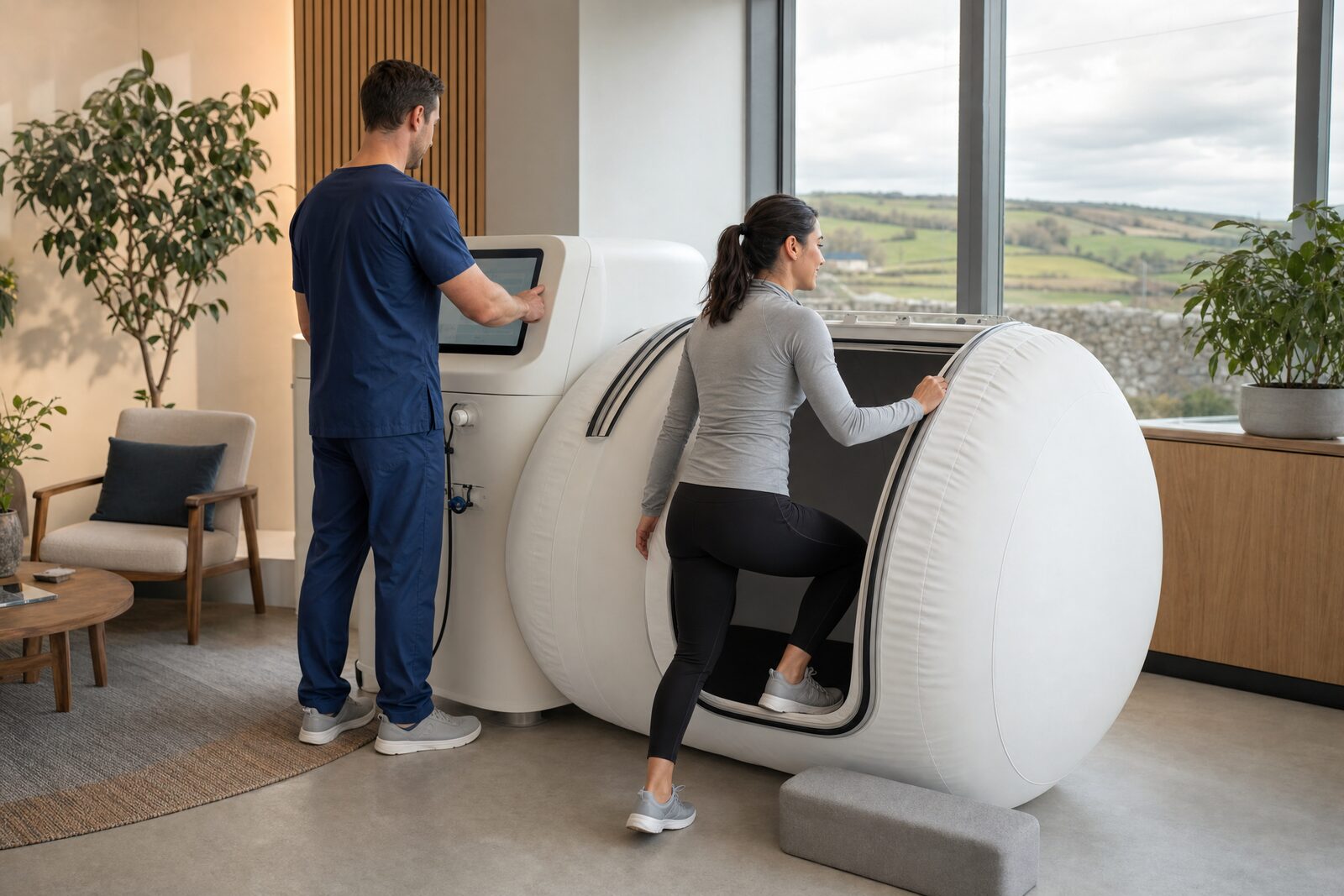
A mild hyperbaric chamber is typically a flexible, fabric-and-zip enclosure, often shaped like a large capsule or tube, that inflates to a pressure of around 1.3 to 1.5 atmospheres absolute (ATA). Inside, most soft chambers do not deliver pure oxygen to the whole space, since pressurising a fabric chamber with 100% oxygen would be a serious fire hazard. Instead, an oxygen concentrator feeds an enriched air mix, commonly in the region of 24 to 34% oxygen compared with the roughly 21% in normal air, and many setups deliver a higher concentration directly to the user through a mask or nasal cannula while the chamber itself holds the lower pressure.
These chambers are widely marketed in Ireland for general recovery, sleep, jet lag, mild fatigue and post-exercise soreness, and as an add-on at longevity and biohacking-style clinics. Session lengths are usually 60 to 90 minutes, and providers often sell courses of 10 or more sessions. The appeal is real: mild pressurisation with supplemental oxygen is generally low-risk for healthy adults, and some people report feeling more rested or recovering faster after a course. What is less settled is how much of that benefit comes from the mild pressure and oxygen itself, as opposed to the relaxation of lying still for an hour, the placebo response, or the accompanying advice on sleep and hydration that often comes with a wellness package. For most of the conditions mild chambers are marketed against, the evidence base is thin, in animal or small uncontrolled human studies rather than the kind of randomised, placebo-controlled trials that would let a clinic honestly say a mild session improves a specific health outcome.
Medical (hard-shell) chambers: what they are and what they do
A medical hyperbaric chamber is a rigid steel or acrylic vessel, either a single-occupant monoplace chamber or a larger multiplace chamber that can treat several patients and staff together. These chambers reach considerably higher pressures, typically 2.0 to 3.0 ATA, and patients breathe 100% medical-grade oxygen, usually through a tight-fitting mask, hood, or an oxygen-tight breathing circuit built into the chamber itself. Because pure oxygen at high pressure is both more physiologically potent and more flammable, medical chambers are built to a much stricter engineering and safety standard, including features such as an entry airlock, a medical lock for passing items in and out without depressurising the whole unit, fire suppression systems, and continuous monitoring of oxygen levels inside the chamber.
Medical HBOT is delivered under clinical supervision, typically with a doctor or specialist nurse assessing suitability beforehand and staff present throughout each session, and it is aimed at a defined list of conditions where the physiological effects of very high blood oxygen levels, such as enhanced white blood cell function, new blood vessel growth and reduced tissue swelling, have a genuine, evidence-supported mechanism of benefit. This is the version of HBOT used in hospitals worldwide, including Ireland's own national unit, for conditions such as chronic non-healing wounds (particularly in people with diabetes), certain radiation injuries following cancer treatment, decompression illness in divers, severe carbon monoxide poisoning, and a small number of other acute and chronic conditions recognised by professional hyperbaric medicine bodies.
How the evidence differs between the two
It is worth being direct about this, because it is the single most important distinction between mild and medical HBOT. For the approved medical indications, hyperbaric oxygen at 2.0 ATA or higher with 100% oxygen has a substantial evidence base built over decades, including randomised trials for conditions like diabetic foot ulcers and case series and physiological studies supporting its use in decompression illness and carbon monoxide poisoning. Professional bodies such as the Undersea and Hyperbaric Medical Society maintain a defined, periodically reviewed list of indications precisely because the evidence for those specific uses has been assessed and found sufficient.
For the wellness uses that mild chambers are typically marketed for, such as general anti-ageing, cognitive sharpness, athletic recovery or sleep quality, the picture is different. Some small studies and case reports describe benefits, and there is a plausible mechanism, since even modestly elevated oxygen delivery could support tissue repair. But this is, at best, promising and unproven territory rather than an established clinical benefit, and the sessions on offer at wellness studios are running at meaningfully lower pressure and lower oxygen concentration than the protocols used in the medical trials people sometimes point to when marketing mild HBOT. If a wellness provider quotes a specific clinical trial to justify a soft-chamber wellness session, it is reasonable to ask whether that trial actually used a hard-shell chamber at 100% oxygen and a higher ATA, because carrying evidence across a different pressure and gas mix is one of the more common ways HBOT marketing overstates what a lower-intensity session can deliver.
Regulation and safety oversight in Ireland
Hyperbaric chambers used for a medical purpose in Ireland fall under the Health Products Regulatory Authority's medical devices framework, which implements the EU Medical Devices Regulation. Chambers intended for medical treatment are generally built and CE-marked to the European standard for hyperbaric chambers used clinically, and reputable Irish medical HBOT providers will be able to point to this certification along with details of their engineering safety features, such as an antechamber, medical lock and fire suppression system. The HPRA's role covers the devices themselves and the claims made about medicinal use, and it has previously acted against promotion of unauthorised health claims where the evidence did not support them.
Wellness-oriented mild chambers occupy a greyer regulatory space. Because they are marketed for general wellbeing rather than to treat a defined medical condition, they are not always subject to the same medical device certification as hospital-grade equipment, which is one more reason the engineering standards, oxygen source and safety protocols can vary considerably between wellness providers. Before booking, it is reasonable to ask any Irish HBOT provider, mild or medical, what pressure they operate at, what oxygen source they use, whether they hold specific medical device certification, and what their intake screening and emergency procedures look like.
Cost in Ireland: mild versus medical
For wellness-oriented mild HBOT in the Republic of Ireland, a single session in 2026 typically costs somewhere in the region of €100 to €150, broadly in line with pricing across the sector's soft-chamber studios, with courses of 10 or more sessions usually bringing the effective per-session price down. Private medical-grade HBOT, where a hard-shell chamber, 100% medical oxygen and clinical supervision are involved, tends to sit at a similar or somewhat higher per-session price once you account for the additional staffing, oxygen supply and equipment standards involved, and a course for a specific medical indication is usually recommended by a clinician rather than sold as a fixed package.
The route many people are not aware of is that if your condition is one of the recognised medical indications, hyperbaric oxygen is available through Ireland's public health system. The HSE's National Hyperbaric Medicine Unit, based at University Hospital Galway, treats patients with recognised indications following referral, meaning eligible patients access medical-grade HBOT without the private per-session cost that applies to wellness use. This is a meaningful distinction: paying privately for wellness-style mild sessions makes sense for people chasing a general wellbeing benefit, but anyone with a condition that might qualify for medical HBOT should ask their GP or specialist about a referral to the public unit before assuming a private wellness clinic is the only option. Prices last checked September 2026 and vary between providers, so confirm current rates directly with any clinic before booking.
Who should choose which
If you have a specific, diagnosed medical condition on the recognised indications list, the sensible path is medical HBOT delivered under clinical supervision, ideally after discussing referral to the HSE's hyperbaric unit with your GP or specialist, or via a private provider offering genuine medical-grade, HPRA-compliant treatment if public access is not practical for your situation. This is not a setting where a soft-shell wellness chamber running at 1.3 ATA on enriched air is a substitute, because the pressure and oxygen delivery that make a real physiological difference for wound healing or decompression illness simply are not present at wellness-chamber settings.
If your interest is general recovery, relaxation or curiosity about the wellness trend rather than treatment of a diagnosed condition, a mild chamber session is a lower-risk, lower-cost way to try HBOT, provided the operator is transparent about pressure and oxygen source and screens you properly beforehand. Just go in with realistic expectations: you are trying something plausible but not established, not undergoing a treatment with the same evidence base as the medical version, and any specific health claims a wellness provider makes about it deserve the same scepticism you would apply to any other unproven wellness product.
Risks and who should be cautious with either type
Both mild and medical HBOT carry some of the same core risks, because both involve pressure changes and elevated oxygen. Ear and sinus barotrauma, essentially pressure-related discomfort or injury to the middle ear, is the most common issue and is why providers teach equalisation techniques such as swallowing or a gentle Valsalva manoeuvre before and during pressurisation. Claustrophobia can be a genuine barrier for some people in either chamber type, though soft chambers are sometimes seen as less confining. People with an untreated pneumothorax, certain severe lung conditions, uncontrolled seizure disorders, or specific ear conditions are generally advised against HBOT of either kind, and pregnancy is typically approached with particular caution and a clinician's input.
Medical hard-shell chambers using 100% oxygen at higher pressure carry an additional, well-recognised risk: oxygen toxicity affecting the central nervous system or lungs with prolonged or repeated high-pressure exposure, which is precisely why medical sessions are time-limited, monitored and delivered under clinical protocols rather than sold as an unsupervised wellness product. Fire risk is also a serious engineering consideration in any pure-oxygen environment, which is one reason medical chambers are built and certified to a much stricter standard than fabric wellness pods. None of this means either chamber type is unsafe when properly run, but it does mean that a proper intake screening, whether you are booking a mild wellness session or a medical course, is not a formality to skip.
The bottom line
Mild and medical hyperbaric oxygen therapy share a name and a basic principle, breathing extra oxygen under increased pressure, but they differ meaningfully in pressure, oxygen source, regulatory oversight, cost and, most importantly, in how well their respective uses are actually supported by evidence. Medical HBOT for its recognised indications is a genuine, HSE-supported clinical treatment with decades of evidence behind it. Mild HBOT for general wellness is a plausible, low-risk way to spend an hour that has not been shown to deliver the specific health benefits sometimes claimed for it. Knowing which one you are booking, and what its evidence actually supports, is the difference between an informed decision and an expensive guess.