What hyperbaric oxygen therapy actually is
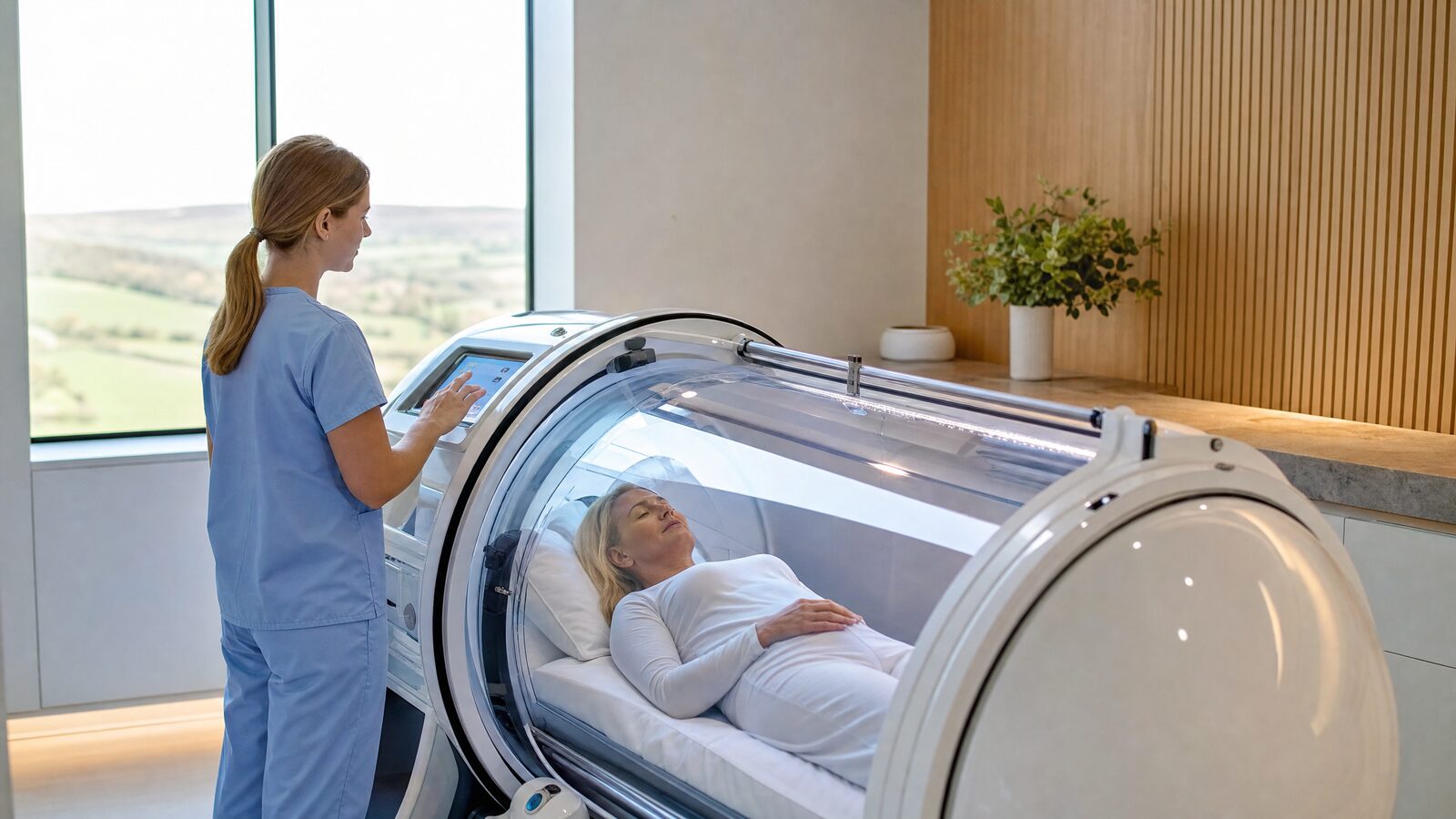
Hyperbaric oxygen therapy, usually shortened to HBOT, involves breathing oxygen inside a pressurised chamber. The pressure inside the chamber is raised above normal atmospheric pressure, which allows your lungs to take in far more oxygen than they could at sea level. That extra oxygen dissolves into your blood plasma and is carried around the body, and the theory is that flooding the tissues with oxygen in this way supports healing, reduces inflammation and helps the body repair itself.
It is important to understand from the outset that there are really two worlds of HBOT in Ireland, and they are not the same thing. On one side is medical HBOT, delivered in a hospital or specialist unit at higher pressures, typically around 2.0 to 2.8 times atmospheric pressure, and used to treat a defined list of recognised conditions. On the other side is the fast-growing wellness sector, where private clinics offer what is often called mild HBOT at gentler pressures, marketed for recovery, energy, skin and general wellbeing.
The distinction matters enormously when it comes to cost, because the price you pay, and whether anyone else helps pay it, depends heavily on which type you are accessing and why. Most people searching for HBOT prices in Ireland are looking at the private wellness clinics, so that is where we will focus, while being clear about how the medical route differs.
How much does HBOT cost in Ireland?
For private wellness HBOT in the Republic of Ireland, a single session in 2026 typically costs somewhere between €100 and €150. A common headline rate for a one-off session is around €135, and that is a useful figure to anchor your expectations. Some clinics price slightly below this and a few premium settings sit a little above it, but the great majority of single-session prices cluster in that €100 to €150 band.
Where the real value lies is in buying a course rather than paying session by session. Because HBOT is almost always recommended as a series rather than a one-off, clinics build their pricing around packages, and the per-session cost falls as the package gets bigger. As a representative example, a Galway clinic prices single sessions at €135, a five-session package at €600, which works out at €120 each, a ten-session package at €1,100, or €110 each, and a twenty-session package at €2,000, which brings it down to €100 per session. That pattern, where the biggest courses drop the price to around €100 a session, is fairly typical of the Irish market.
There can also be small extra costs to factor in. Some clinics require you to buy a personal reusable oxygen mask, often around €35 as a one-off, for hygiene reasons. Many also offer payment plans or finance options that spread the cost of a larger course over several months, which can make a twenty-session programme more manageable even though the total outlay is the same.
HBOT prices in Northern Ireland
If you are in Northern Ireland, or close enough to the border to consider travelling, the pricing picture looks a little different because it is quoted in sterling and tends to sit lower than in the Republic. Wellness HBOT providers around Belfast and the wider region commonly charge in the region of £35 to £45 for a single session, sometimes with the first introductory session priced slightly higher than subsequent ones.
As with the Republic, packages are where the savings appear. A five-session bundle might be priced around £150 and a ten-session course around £280, again lowering the effective per-session cost. For someone planning a longer programme, these northern prices can work out noticeably cheaper than equivalent courses in the south, though you should weigh that against travel time and cost if you are coming from further away.
The reasons for the price gap are partly currency and partly the local market, and it is worth remembering that a lower price does not automatically mean a lesser service. What matters far more than a few euro or pounds either way is the quality and safety of the setup, the pressure the chamber operates at, and who is supervising your sessions.
Why do HBOT prices vary so much?
The first and biggest driver of price is the type of chamber and the pressure it runs at. Hard-shell chambers capable of higher medical-grade pressures are expensive pieces of equipment, and clinics running them will price accordingly. Softer, portable chambers used for mild HBOT at lower pressures cost less to run, which is part of why wellness sessions can be offered at accessible prices. Neither is inherently better for every purpose, but they are genuinely different treatments and the price reflects that.
The second factor is what is bundled into the session. A clinic that includes an initial consultation, health screening and ongoing supervision by a trained operator or clinician is offering more than one that simply sells chamber time, and that care is built into the price. Location plays a part too, with clinics in Dublin and other cities sometimes charging a little more than those in smaller towns, reflecting local overheads.
Finally, the number of sessions you commit to changes the maths completely. Because clinics discount heavily for volume, the person buying a single curiosity session pays the most per visit, while someone committing to a full course of ten or twenty pays significantly less each time. If you already know you want a sustained programme, it almost always makes sense to price the packages rather than paying drop-in rates.
Does the HSE or health insurance cover HBOT?
This is where expectations need to be realistic. Medical HBOT for recognised conditions, such as decompression sickness in divers, carbon monoxide poisoning, certain non-healing wounds and radiation tissue damage, is delivered through the hospital system rather than through wellness clinics, and access to it is arranged clinically through referral, not bought off a price list. If you have one of those conditions, the pathway is a medical one and cost is handled very differently.
The wellness uses that most people are curious about, including recovery, energy, anti-ageing, skin and general wellbeing, are considered off-label and are generally not funded by the HSE. Private health insurers likewise tend not to reimburse HBOT sessions taken for these purposes, treating them as elective wellness spending rather than medical treatment. In practice this means that if you walk into a private clinic for a wellness course, you should expect to pay the full cost yourself.
Because the financial commitment falls entirely on you, it is worth being clear-eyed about what you are buying and why before you sign up for a large package. It is also worth asking any clinic directly whether there is any circumstance in which your treatment might be medically indicated, because if it is, there may be a more appropriate and better-funded route than paying privately for mild HBOT.
What happens during a session, and how many will you need?
A typical HBOT session is a fairly relaxed experience. After any initial screening, you enter the chamber, which is then gradually pressurised. During the descent, as the pressure rises, you will feel your ears needing to equalise, much as you do on an aircraft, and you will be shown how to clear them comfortably. Once at pressure, you simply breathe as normal, often through a mask delivering the oxygen, and many people read, listen to audio or simply rest for the duration.
Sessions commonly last around sixty to ninety minutes at pressure, plus a few minutes each side for pressurising and depressurising. Because the claimed benefits are thought to build cumulatively, clinics rarely present HBOT as a single-session fix. Wellness courses are frequently structured as blocks of ten, twenty or more sessions, sometimes taken several times a week over a number of weeks, which is precisely why the package pricing matters so much to the overall cost.
When you are budgeting, then, the realistic figure to think about is not the price of one session but the price of a course. A programme of ten sessions at a typical Irish clinic might total somewhere around €1,100, and a twenty-session block around €2,000, so HBOT is best thought of as a multi-hundred to low-thousands commitment rather than a casual once-off.
Is HBOT worth the cost?
Whether HBOT represents good value depends heavily on what you are hoping to get from it. For the medically recognised indications, the evidence base is strong and the treatment is genuinely established, but those cases go through the hospital system rather than the wellness market. For the wellness claims that draw most private customers, the honest position is that the evidence is mixed and still developing, with some promising research in areas such as recovery and certain aspects of ageing, but far from the level of proof that would justify treating it as a certain intervention.
That does not mean a wellness course is pointless, but it does mean you should approach it as an experiment with realistic expectations rather than a proven cure. Many users report feeling more energetic or recovering faster, and that experience is real to them, but it is difficult to separate a true physiological effect from rest, routine and expectation. If you are curious, financially comfortable and going in with clear eyes, a trial course can be a reasonable thing to try.
What you should not do is stretch your budget for HBOT at the expense of the fundamentals that reliably support healthy ageing, namely sleep, movement, good nutrition and stress management. Think of HBOT as an optional extra on top of those basics, and judge it by how you actually feel over a course rather than by the marketing that surrounds it.
How to choose an HBOT clinic in Ireland
Safety and transparency should guide your choice far more than price alone. The most important questions to ask are what pressure the chamber operates at, what training the staff supervising your sessions have, and what screening they carry out before treating you. A responsible clinic will happily tell you these things and will ask about your medical history, current medications and any conditions that might make HBOT unsuitable, rather than simply selling you chamber time.
HBOT is not appropriate for everyone. People with certain lung conditions, recent ear or sinus problems, some types of chest issues and a few other specific circumstances may need to avoid it or be assessed carefully first, which is exactly why proper screening matters. If a clinic shows no interest in your health background and is only interested in selling a package, that is a warning sign worth heeding.
Beyond safety, look for clear, honest pricing that sets out single-session and package rates, realistic and non-hyped descriptions of what HBOT can and cannot do, and clean, professional premises. You can compare hyperbaric oxygen therapy providers and other longevity clinics across Ireland in the Gerovia directory, which is a practical way to shortlist reputable options in Dublin, Galway, Belfast or your local area before you commit to a course.