What "red light therapy for hair loss" actually refers to
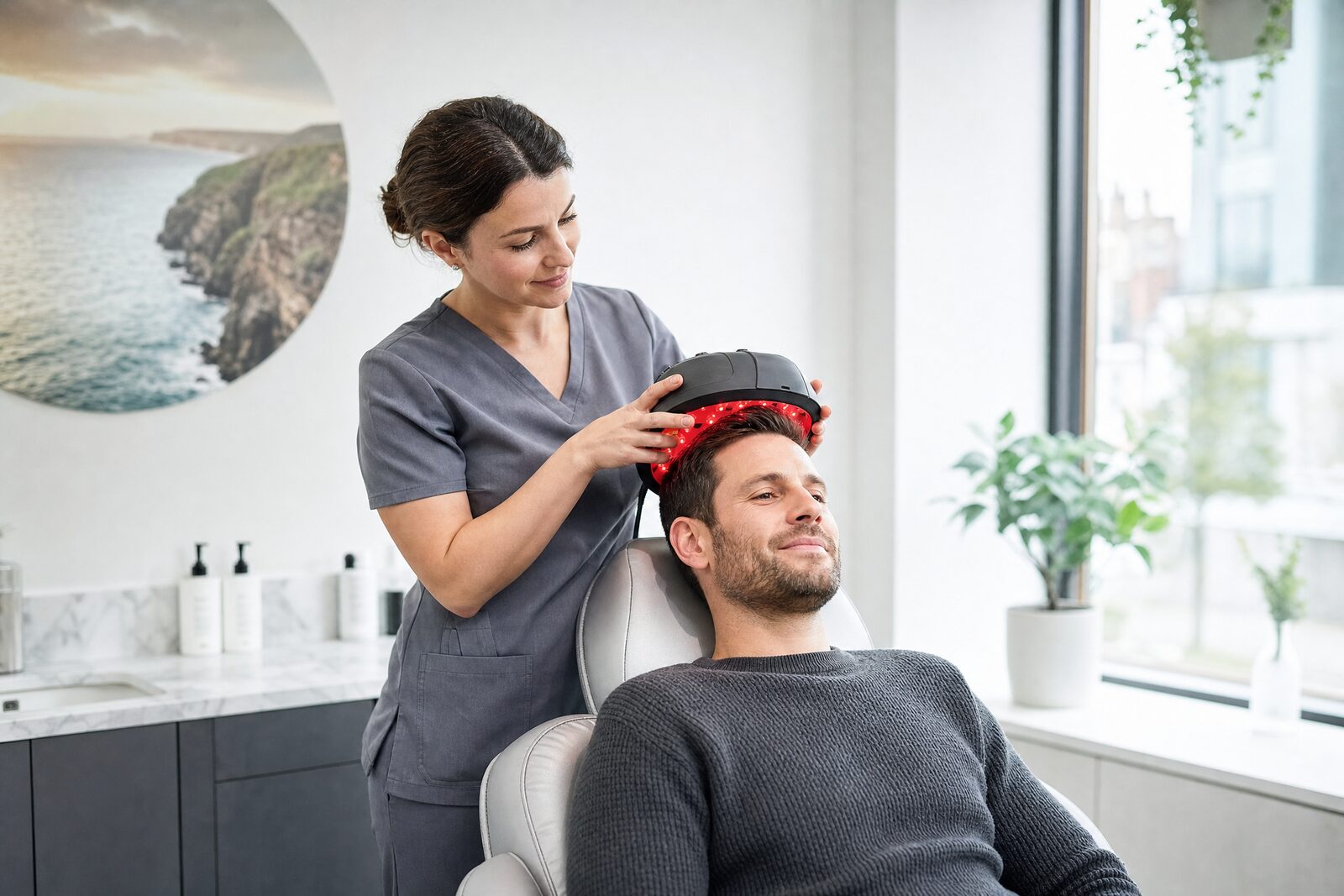
When people talk about red light therapy for hair loss, they are usually describing low-level laser therapy or LED therapy, commonly abbreviated LLLT, delivered through devices such as in-clinic laser helmets, handheld combs, or wearable caps and bands for home use. These devices emit red and near-infrared light, typically in the 630 to 660 nanometre range for red wavelengths, aimed at the scalp. The proposed mechanism is the same photobiomodulation effect used elsewhere in red light therapy: light in this range is absorbed by cytochrome c oxidase in the mitochondria of scalp cells, which is thought to increase cellular energy production, improve local blood flow, and shift hair follicles that have shrunk or gone dormant back into an active growth phase.
This is a genuinely different situation from many other wellness applications of red light, because hair loss is one of the few areas where LLLT devices have gone through a reasonable amount of controlled clinical testing, and where some devices have received regulatory clearance specifically for treating pattern hair loss. That does not mean every claim made for it holds up, but it does mean there is real trial data to examine rather than mostly speculation.
What the evidence actually shows
The strongest piece of evidence is a 2025 systematic review and meta-analysis that pooled 38 studies covering 3,098 patients with various types of alopecia, the large majority (2,930 patients) with androgenetic alopecia specifically. It found a statistically significant increase in hair density after four to 26 weeks of LLLT compared with placebo or sham devices, with the effect size actually somewhat larger after more than 20 weeks of use than in the shorter term. That is a meaningful result: a large pooled sample, a clear direction of effect, and a plausible dose-response pattern where longer use produced a bigger measured difference.
The honest caveat is that the studies included were highly variable in their design, device type, wavelength, treatment schedule and how they measured hair density, which is reflected in a very high statistical heterogeneity score in the pooled analysis. In plain terms, some studies found a large benefit and others found much less, and the true average effect for any individual device or protocol is harder to pin down than the headline finding suggests. Adding to that picture, a smaller randomised controlled trial that compared LLLT plus topical minoxidil against minoxidil alone in 54 patients over 16 weeks found no statistically significant difference in hair density improvement between the two groups, and no meaningful difference in physician or patient-reported satisfaction. That does not contradict the larger meta-analysis so much as it illustrates the same heterogeneity problem: this is a treatment with a real average effect across pooled data, but it is not something that reliably outperforms established treatments in every individual trial, and it may add less on top of minoxidil specifically than it does on its own.
Who it works best for, and who it probably will not help
The evidence for LLLT is concentrated almost entirely in androgenetic alopecia, the genetic, hormone-driven pattern hair loss that affects both men (typically a receding hairline and crown thinning) and women (typically diffuse thinning across the crown). This makes biological sense, because androgenetic alopecia involves follicles that are miniaturising but are still alive and potentially responsive to stimulation, which is the situation LLLT's proposed mechanism is best suited to influence. People in the earlier stages of thinning, with follicles that have shrunk rather than scarred over or disappeared entirely, are generally considered the best candidates.
For other causes of hair loss, the picture is far less supported. Alopecia areata, an autoimmune condition, and telogen effluvium, a stress- or illness-related shedding pattern, were included in the 2025 meta-analysis in much smaller numbers, and the review itself noted there was not enough data to draw a reliable conclusion for those conditions. Scarring alopecias, where the follicle itself has been destroyed, are a poor candidate for any hair-stimulating treatment, including LLLT, because there is no living follicle left to stimulate. If your hair loss has a sudden onset, comes with visible scalp inflammation or scarring, or is patchy rather than a typical pattern-thinning distribution, a dermatologist assessment matters more than any device, because the underlying cause changes what is worth trying.
How it compares with minoxidil and finasteride
Minoxidil, applied topically or increasingly used at a low oral dose under medical supervision, and finasteride, an oral prescription medicine for male pattern hair loss, both have a considerably longer and more consistent evidence trail than LLLT, including large randomised trials directly measuring hair count and patient-rated outcomes. Where LLLT has generally been tested is as a stand-alone option for people who want to avoid medication, or as an add-on alongside minoxidil or finasteride, and the trial comparing LLLT plus minoxidil against minoxidil alone is a useful reality check here: it suggests the added value of LLLT on top of an already-effective treatment may be smaller than marketing for combination protocols implies, at least in that particular trial's population and timeframe.
A reasonable, evidence-consistent way to think about LLLT is as a lower-effect-size, lower-risk option that fits well for people who cannot or do not want to use topical or oral medication, including some women for whom the medication options are more limited, or as a genuinely optional add-on for people already on minoxidil or finasteride who want to try something with minimal downside. It is not a substitute with an equivalent evidence base to either medication, and anyone expecting LLLT alone to match what a prescription-strength treatment delivers is likely to be disappointed.
Device types and what to look for
In-clinic and at-home LLLT devices for hair loss come in several formats: full-coverage caps or helmets that house dozens of small laser diodes or LEDs and are worn hands-free, combs that require manually moving the device across sections of the scalp, and handheld panels held close to the scalp. In general, cap and helmet-style devices that cover the whole scalp evenly in one session tend to be easier to use consistently, which matters because most of the positive trial data involved several sessions a week over months, not occasional use.
A genuine point of variation between devices is diode count, wavelength and whether the device uses true laser diodes, LEDs, or a mix of both, and reputable manufacturers publish these specifications rather than relying on vague marketing language. When comparing options, it is reasonable to ask what wavelength the device uses (look for something in the mid-600s nanometre range, consistent with the wavelengths tested in the clinical literature), how many diodes it has, and what treatment frequency the manufacturer recommends based on their own testing, since consistency of use over months appears to matter more than any single session.
Cost and access in Ireland
In-clinic scalp LLLT is offered by some hair restoration and dermatology-adjacent clinics in Dublin, Cork, Galway and Belfast, sometimes as a stand-alone treatment and sometimes bundled with other hair-restoration services such as PRP. Where it is offered as part of the broader red light therapy market rather than a dedicated hair programme, pricing tends to sit in the same range as general red light sessions in Ireland, roughly €25 for a single session up to the low nineties of euro depending on the setting and equipment, with multi-session packages bringing the per-session cost down.
For most people, at-home devices are the more practical route given how often LLLT needs to be used for a meaningful trial. Handheld combs and smaller cap devices are commonly available from around €150 to €400, while larger, higher-diode-count caps and helmets can run from roughly €400 to €800 or more. This is a one-off purchase rather than a recurring cost, which can make it more economical than repeated clinic visits if you intend to use it consistently for the four to six months or longer that the trial evidence suggests is needed to judge whether it is working for you. Prices last checked September 2026 and vary by retailer and device specification, so compare current listings before buying.
Safety and realistic expectations
LLLT for hair loss has a favourable safety profile in the trial literature, with mild scalp warmth or occasional dryness among the more commonly reported effects and no serious adverse events consistently linked to properly specified devices used as directed. This is one of the reasons it is often suggested as an add-on rather than an either-or choice against medication: the downside risk is low even if the added benefit turns out to be modest for a given individual.
The more important expectation to set correctly is timeline and degree. The trial evidence measures hair density improvements over four to 26 weeks, with better results generally seen with continued use beyond 20 weeks, and even the positive pooled result is a moderate average effect, not a dramatic regrowth outcome. Realistic goals are slowing further thinning and modestly improving density in areas where follicles are miniaturised but still active, not reversing established, long-standing bald patches where follicles are no longer functional. Photographing your scalp under consistent lighting every few months is a more reliable way to judge your own results than relying on how your hair feels day to day.
The bottom line
Red light therapy for hair loss, in the form of low-level laser and LED devices, is one of the more genuinely evidenced non-drug options in the hair loss space, backed by a sizeable pooled analysis showing a real, if modest and variable, increase in hair density for androgenetic alopecia. It is not a proven match for minoxidil or finasteride's evidence base, and at least one trial found no added benefit when combined with minoxidil specifically, so it is best approached as a low-risk option for people who want to avoid medication, or a reasonable add-on for those already on one, rather than a stand-alone cure for pattern hair loss. If you go this route, choose a device with published specifications in the tested wavelength range, commit to using it consistently for several months, and keep your expectations calibrated to what the trial data actually shows.