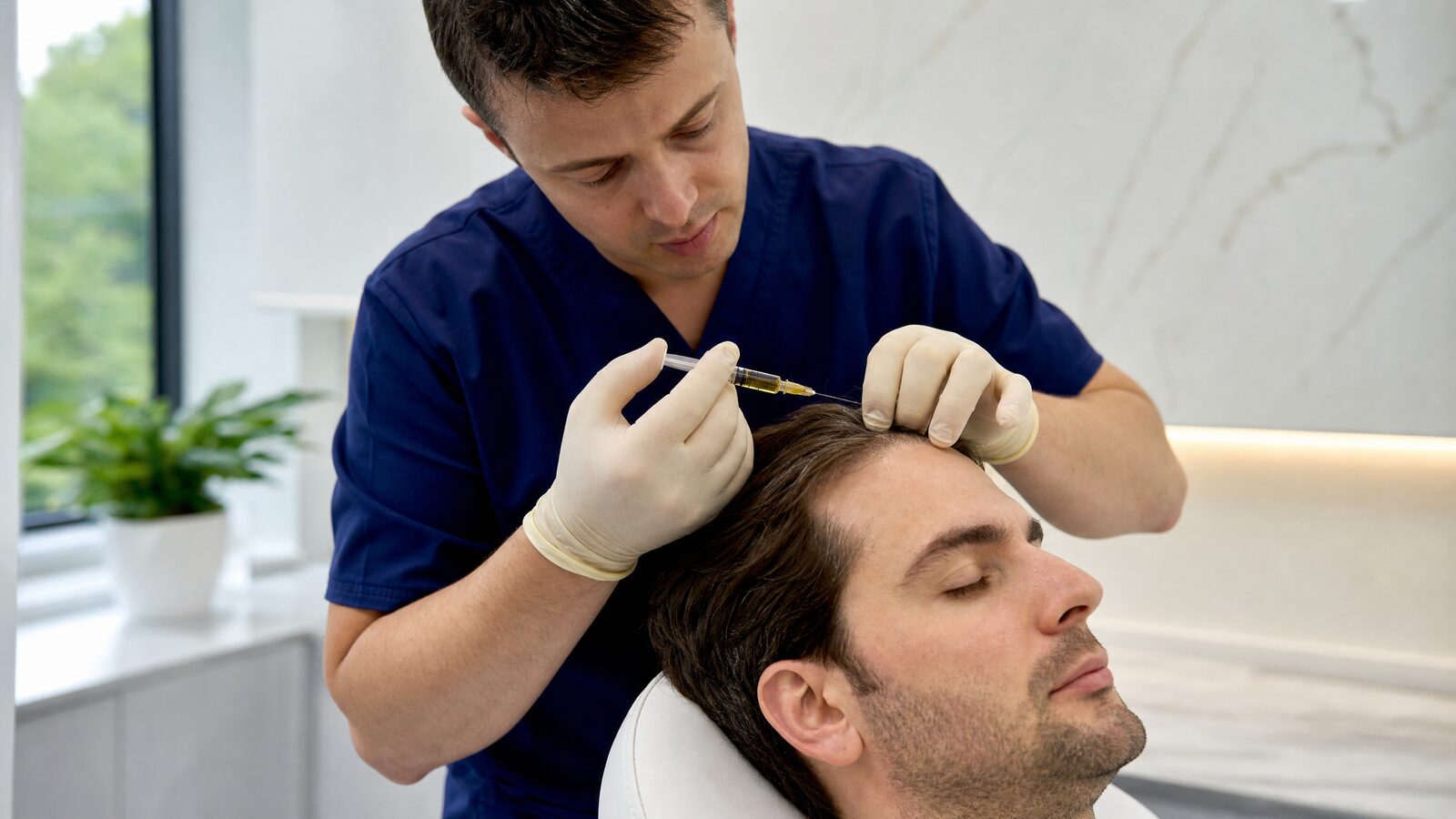
What is PRP therapy for hair loss?
PRP stands for platelet-rich plasma, a concentration of platelets derived from your own blood that is injected directly into the scalp to stimulate hair follicles. The process begins with a standard blood draw, usually from the arm. That blood is then placed in a centrifuge, a machine that spins it at high speed to separate the platelet-rich layer from the rest of the blood components. The resulting plasma contains a far higher concentration of platelets, and therefore a far higher concentration of the growth factors those platelets release, than your blood normally carries.
When this concentrated plasma is injected into areas of thinning hair on the scalp, the growth factors are believed to promote healing, increase blood supply to the follicles and encourage dormant or weakened follicles to re-enter an active growth phase. PRP has been used in orthopaedics, dentistry and wound healing for years, and its application to hair restoration has grown rapidly over the past decade as the evidence base has expanded.
In Ireland, PRP for hair loss is now offered by dermatology clinics, aesthetic medicine practices and specialist hair restoration centres in cities including Dublin, Cork, Galway and Limerick. It is classed as a cosmetic or elective procedure, meaning it sits outside the public health system. A registered medical practitioner should always be the person performing the injections or directly supervising the treatment, as required by the Medical Council of Ireland.
Does PRP actually work for hair loss? What the evidence says
This is the question that matters most, and the honest answer is encouraging. The evidence for PRP in the treatment of androgenetic alopecia, the most common form of hair loss in both men and women, has strengthened considerably in recent years. Multiple systematic reviews and meta-analyses have now been published, and the overall trend is positive. A 2025 meta-analysis published in Springer found that PRP significantly increases hair density compared with control treatments. A 2024 meta-analysis in ScienceDirect confirmed that PRP is capable of increasing hair density in patients with androgenic alopecia, adding further weight to the body of evidence.
Some studies have found PRP to be comparable to minoxidil, the topical treatment most commonly used as a first-line option for pattern hair loss, in terms of its ability to improve hair density. That is a meaningful benchmark, because minoxidil has decades of clinical use behind it. The comparison suggests PRP is not simply a cosmetic fad but a treatment with a genuine biological mechanism that translates into measurable outcomes in at least some patients.
That said, context matters. The quality of PRP research is improving but still has limitations. Studies vary in how they prepare the PRP, how many sessions they deliver, how they measure outcomes and how long they follow patients. Not every study shows dramatic results, and individual responses can vary widely. PRP is best understood as a treatment with a solid and growing evidence base, particularly for early to moderate androgenetic alopecia, rather than a certain fix for every type of hair loss. If you are considering it, the evidence gives you a reasonable basis for cautious optimism, not a promise of transformation.
How much does PRP for hair loss cost in Ireland?
Cost is one of the first practical questions people ask, so let's be straightforward. In Ireland in 2026, a single PRP session for hair loss typically costs between €250 and €500 at most clinics. Premium clinics, particularly those with specialist dermatologists or advanced preparation protocols, may charge towards the higher end or up to €400 to €900 per session. The variation in price reflects differences in the clinic setting, the expertise of the practitioner, the specific PRP preparation method used and the level of consultation and aftercare included.
Because PRP for hair restoration is almost always delivered as a course rather than a one-off treatment, the total investment matters more than the single-session figure. Most protocols call for three to six sessions spaced roughly four to eight weeks apart, meaning the initial course could cost anywhere from around €750 at the lower end to €3,000 or more at the top. Some clinics offer package deals that bundle sessions together at a reduced per-session rate, which is worth asking about before you commit to your first appointment.
It is important to be clear that PRP for hair loss is not covered by Irish health insurance. It is classified as an elective cosmetic procedure, so the full cost falls on the patient. No private health insurer in Ireland reimburses it, and it is not available through the public system. You should also factor in maintenance sessions, which are typically recommended every six to twelve months after the initial course to sustain results, adding an ongoing cost that is easy to overlook at the outset.
Who is a good candidate for PRP hair treatment?
PRP is not equally effective for everyone, and understanding who benefits most will help you set realistic expectations. The strongest evidence and the best clinical outcomes are seen in people with early-stage hair thinning, particularly androgenetic alopecia, where the follicles are miniaturised and weakened but not yet completely dead. In these cases, PRP can help to reinvigorate follicles that are still capable of producing hair, encouraging thicker, healthier growth over time.
Both men and women can be candidates, and in fact PRP is one of the few treatments for female pattern hair loss that has shown promising results. People who notice their hair becoming thinner, their parting widening, or their scalp becoming more visible through their hair are often in the window where PRP can be most useful. If you are in your twenties, thirties or forties and starting to see the early signs of thinning, the treatment is more likely to deliver a noticeable improvement than if you wait until loss is advanced.
Conversely, PRP is generally less effective for areas of complete baldness where follicles have been absent for a long time. Once a follicle has truly died and the scalp has scarred over, there is no dormant structure left for the growth factors to act on. People with very advanced hair loss, those whose thinning is caused by autoimmune conditions, scarring alopecias or medical treatments, and anyone with blood disorders or platelet abnormalities should discuss suitability carefully with a doctor before proceeding. A responsible clinic will assess your hair loss pattern, your medical history and your expectations before recommending a treatment plan, and a good practitioner will tell you honestly if PRP is unlikely to help in your particular case.
What to expect during and after PRP treatment
A PRP session for hair loss is a relatively quick procedure, typically taking between 45 minutes and an hour from start to finish. It begins with a blood draw, usually around 20 to 60 millilitres from a vein in your arm, much like a standard blood test. That sample is placed in a centrifuge for around ten to fifteen minutes to separate the platelet-rich plasma from the red blood cells and other components. While the centrifuge runs, the practitioner may apply a topical numbing cream to your scalp to reduce discomfort during the injection phase.
Once the PRP is ready, it is injected into the scalp using a fine needle, typically in a grid pattern across the areas of thinning. Most patients describe the sensation as a series of small pinches or a mild stinging, manageable but not painless. The number of injection points varies depending on the area being treated but can range from dozens to over a hundred across the scalp. The entire injection phase usually takes around twenty to thirty minutes. Some clinics use a microneedling device alongside PRP to enhance absorption, which may cause a little more surface tenderness.
Afterwards, you can generally return to your normal activities the same day. The most common side effects are mild and localised: scalp tenderness, minor swelling at the injection sites, and occasionally some redness or a slight headache. These typically resolve within a day or two. Practitioners usually advise avoiding vigorous exercise, washing the hair, and direct sun exposure for the first 24 to 48 hours. Results are not immediate. Most patients begin to notice improvements in hair thickness and density after three to six months, with the full effect becoming apparent as the course progresses and the growth cycle responds.
PRP combined with other hair loss treatments
One of the practical advantages of PRP is that it can be used alongside other established hair loss treatments rather than in isolation. Many dermatologists and hair restoration specialists recommend combining PRP with minoxidil, finasteride or both, particularly for patients with androgenetic alopecia who want to maximise their results. The rationale is straightforward: each treatment works through a different mechanism, so using them together can address hair loss from multiple angles simultaneously.
Minoxidil, applied topically to the scalp, works primarily by increasing blood flow to the follicles and prolonging the growth phase of the hair cycle. Finasteride, taken orally, blocks the conversion of testosterone to dihydrotestosterone, the hormone most directly responsible for follicle miniaturisation in androgenetic alopecia. PRP adds a third mechanism by delivering concentrated growth factors directly to the scalp. Some studies have suggested that patients using PRP in combination with one or both of these treatments see greater improvements in hair density than those using any single approach alone.
If you are already using minoxidil or finasteride and finding the results plateauing, adding PRP sessions may give your regimen an additional boost. Equally, if you prefer to avoid daily medication, PRP offers a periodic, drug-free alternative, though it is worth noting that the evidence for PRP as a standalone is strongest in the context of mild to moderate thinning. Whichever combination you consider, the decision should be made in consultation with a doctor who can assess your specific pattern of loss, your medical history and any potential interactions or contraindications.
Safety, side effects and what to watch for
Because PRP is derived from your own blood, the risk of allergic reaction or rejection is essentially nil, which gives it a strong safety profile compared with treatments that introduce foreign substances. The side effects that do occur are overwhelmingly mild and short-lived. Scalp tenderness at the injection sites is the most commonly reported, followed by minor swelling, redness and occasional bruising. Some patients experience a dull headache on the day of treatment, which typically resolves on its own or with a simple painkiller.
Serious complications are rare but worth being aware of. As with any procedure involving needles, there is a small risk of infection at the injection sites, which is why sterile technique and a clean clinical environment matter. Temporary shedding of hair in the treated area has been reported in a small number of cases in the weeks following treatment, though this is generally considered part of the follicle's transition into a new growth phase and tends to reverse. If you notice anything unusual or persistent after a session, such as significant swelling, signs of infection or unexpected pain, contact your treating clinic promptly.
The most important safety consideration is who performs the treatment. In Ireland, the Medical Council requires practitioners to be registered, and PRP injections to the scalp should only be carried out by or under the direct supervision of a qualified medical professional. Be cautious of providers who cannot clearly tell you who is medically responsible for the procedure, who do not conduct a proper consultation beforehand, or who operate in settings that do not meet basic clinical hygiene standards. A reputable clinic will welcome your questions about credentials, protocols and aftercare, and will be transparent about what the treatment can and cannot do.
How to choose a PRP hair clinic in Ireland
The market for PRP hair treatment in Ireland has grown quickly, and the quality of providers is not uniform. Taking a little time to choose well can make a real difference to both your safety and your results. The first thing to establish is who will be performing the procedure. Look for clinics where a registered doctor or dermatologist carries out the injections or directly supervises them, and where a proper consultation and scalp assessment is conducted before any treatment begins. A clinic that takes your money without first evaluating your hair loss pattern and medical history is not operating to the standard you should expect.
Pricing transparency is another strong signal. A trustworthy provider will be upfront about the cost per session, what is included, whether package pricing is available and how many sessions they recommend for your stage of hair loss. Be wary of clinics that pressure you into large upfront commitments or make extravagant claims about assured regrowth. The evidence for PRP is genuinely encouraging, but no ethical practitioner would promise a specific outcome, because individual responses vary and the treatment has limitations.
PRP is available in Dublin, Cork, Galway and Limerick, with a growing number of clinics in smaller cities and towns also beginning to offer it. When comparing options, pay attention to reviews, the professionalism of the premises, the preparation protocol used for the PRP itself, and whether the clinic offers follow-up assessments to track your progress over time. You can browse and compare PRP and hair restoration providers across Ireland in the Gerovia directory, which is a practical starting point for shortlisting clinics in your area before you book a consultation.
Getting started with PRP for hair loss in Ireland
If you have read this far and PRP sounds like a reasonable option for your situation, the best first step is a consultation rather than a treatment booking. A good initial appointment will include a thorough assessment of your hair loss, a review of your medical history, a discussion of your expectations, and an honest appraisal of whether PRP is likely to help given your pattern and stage of thinning. Use that meeting to ask about pricing, the number of sessions recommended, the preparation protocol for the PRP and the practitioner's experience with the procedure.
Go in with realistic expectations. PRP is not a cure-all and it is not a replacement for the basics of good health. It works best as part of a considered approach that may also include proven medical treatments like minoxidil or finasteride, a healthy diet, stress management and attention to any underlying conditions that might be contributing to hair loss. Results take time, typically three to six months before improvements become visible, and maintenance sessions every six to twelve months are usually needed to sustain them. Patience and consistency matter more than any single session.
When you are ready to explore your options, the Gerovia directory lets you compare PRP and hair restoration clinics across Ireland side by side, with information on locations, treatments offered and practitioner credentials. Whether you are in Dublin, Cork, Galway or elsewhere, finding a qualified, transparent and experienced provider is the single most important decision you will make in this process. Approached with good information and a properly qualified clinician, PRP hair treatment can be a worthwhile step for those dealing with early to moderate hair thinning.