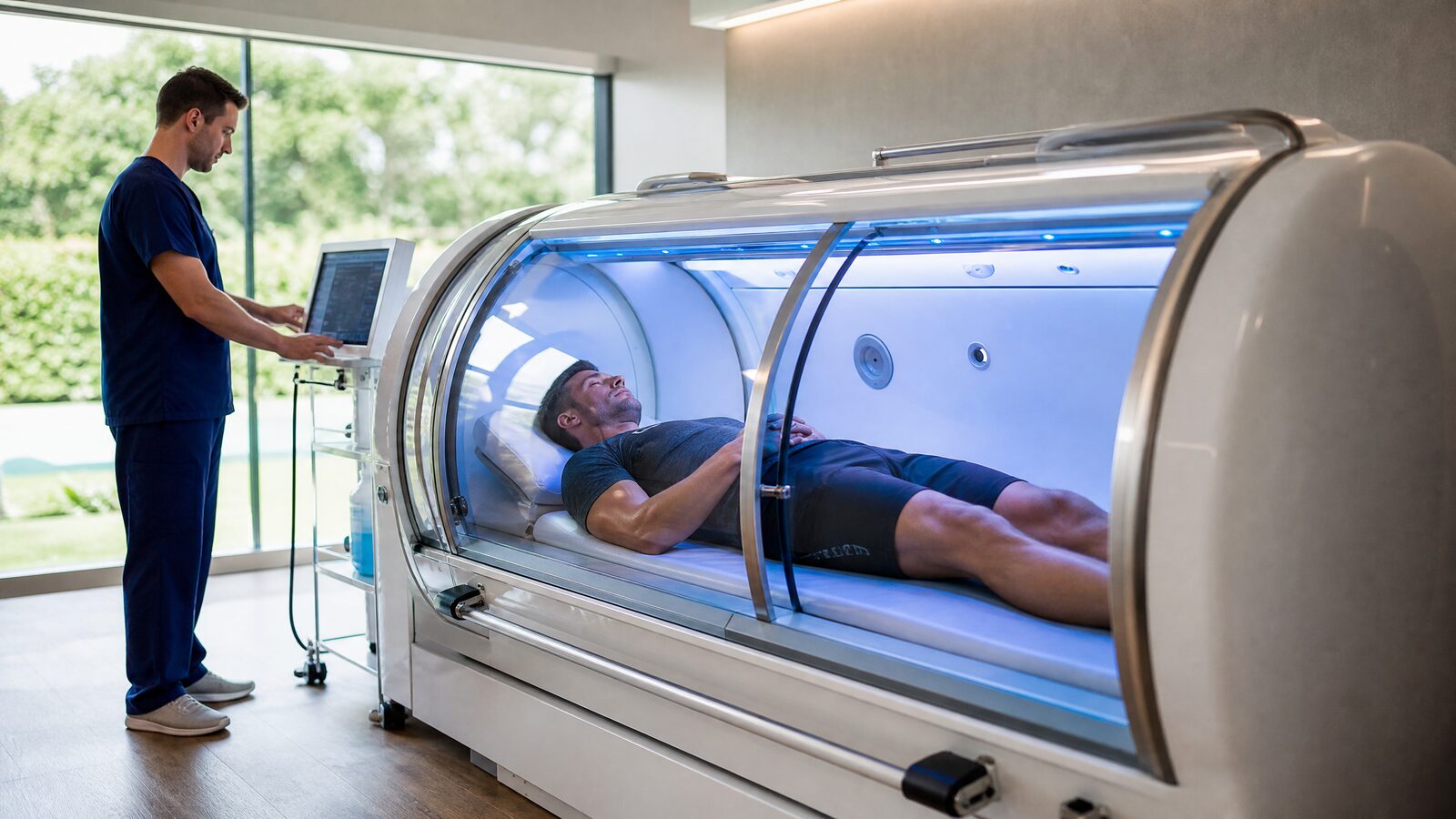
What hyperbaric oxygen therapy is and how it works
Hyperbaric oxygen therapy, commonly known as HBOT, involves breathing oxygen inside a pressurised chamber where the atmospheric pressure is raised to between 1.5 and 2.5 times its normal level. Under these conditions the amount of oxygen dissolved in the blood increases dramatically, well beyond what normal breathing can achieve, and that oxygen-rich blood reaches tissues throughout the body, including areas where circulation may be compromised or where healing is under way. It is a well-established medical treatment for conditions such as decompression sickness and non-healing wounds, and in recent years it has attracted growing interest from the sports and recovery world.
The underlying mechanism is relatively straightforward. At higher atmospheric pressures, oxygen dissolves into the blood plasma rather than relying solely on red blood cells for transport. This means tissues can receive oxygen even where blood flow is restricted by swelling, bruising or micro-damage, which is exactly the situation an athlete's body faces after intense training or competition. At the cellular level, this extra oxygen supports the energy production and repair processes that drive recovery.
For athletes, the appeal is that HBOT may influence several of the body's responses to exercise-induced damage. Research suggests it can reduce oedema through vasoconstriction, inhibit the adhesion of white blood cells that contributes to secondary tissue damage, and help accelerate the transition from the inflammatory phase of healing to the proliferative phase where actual repair takes place. These are the mechanisms that underpin the growing curiosity about HBOT in sporting circles, even though the clinical evidence for healthy athletes remains a work in progress.
Why athletes are turning to HBOT
The demands placed on competitive and recreational athletes in Ireland have never been higher. GAA players routinely face schedules that compress county, club and inter-county commitments into relentless blocks. Rugby players at club and provincial level absorb repeated high-impact collisions across a long season. Cyclists, sprinters and endurance athletes push their bodies through training volumes that leave muscles and connective tissues in a constant state of repair. In this context, anything that might speed recovery between sessions, reduce time lost to injury or help the body cope with accumulated fatigue is going to attract serious attention.
HBOT fits that picture because it targets the recovery process directly rather than simply masking symptoms. Unlike painkillers or anti-inflammatory drugs, which manage how an athlete feels, pressurised oxygen aims to enhance the biological repair happening beneath the surface. For soft-tissue injuries, muscle strains, ligament damage and the general wear and tear of heavy training, the idea that flooding the body with oxygen could meaningfully shorten the timeline from damage to full function is genuinely appealing.
There is also a cultural element. As elite athletes and high-profile sports teams around the world have adopted HBOT as part of their recovery toolkit, awareness has filtered through to club-level competitors and weekend warriors in Ireland. Word of mouth among training partners, coverage of professional athletes crediting HBOT for rapid returns from injury, and the growing availability of chambers in Irish clinics have all contributed to a steady rise in demand. It is no longer seen as exotic or fringe; for a growing number of Irish athletes, it is simply another recovery option alongside ice baths, compression and physiotherapy.
What the evidence says about HBOT and athletic recovery
The honest picture of the evidence is that it is mixed but promising, and anyone considering HBOT for recovery should understand both sides. On the encouraging side, animal studies have demonstrated that HBOT promotes morphological and functional recovery following acute muscular stretch injuries, suggesting that the therapy genuinely supports tissue repair at a biological level. In human research, Webster and colleagues found that participants treated with hyperbaric oxygen showed no decline in peak torque on days one and two after exercise-induced muscle damage, and reported significantly lower pain scores by day five compared to the control group.
However, the picture is not uniformly positive. Harrison and colleagues conducted a controlled trial examining HBOT for exercise-induced muscle damage and found no significant differences between the treated and untreated groups on the measures they examined. This kind of conflicting result is common in sports science research, where individual variation, different exercise protocols and varying HBOT parameters can all influence outcomes. It does not mean the therapy is ineffective, but it does mean that sweeping claims about assured benefits are not yet supported by the weight of the evidence.
For ligament injuries specifically, the evidence is somewhat more encouraging. Ishii and colleagues found that HBOT significantly enhanced ligament healing when applied at 2 ATA for sixty minutes daily, suggesting a genuine therapeutic effect on connective tissue repair. This is particularly relevant for athletes dealing with sprains, partial tears or post-surgical rehabilitation, where ligament recovery often dictates how long a player is sidelined. The responsible takeaway is that HBOT shows real biological promise for accelerating aspects of recovery, but the research is still evolving and no standardised protocol for athletic use has been established.
Where to find HBOT in Ireland and what it costs
The availability of HBOT across Ireland has expanded considerably in recent years. Dublin remains the main hub, with multiple providers offering sessions in both hard-shell and soft-shell chambers. The National Hyperbaric Centre is a well-known facility, and several private wellness clinics in the capital now include HBOT among their services. Cork also has a growing number of providers, reflecting the city's broader embrace of sports medicine and recovery therapies.
Beyond the major cities, regional clinics have begun to fill the gap. Live5DHealth in Boyle, County Roscommon, offers hyperbaric chambers in a more rural setting, making HBOT accessible to athletes in the west and midlands without requiring a trip to Dublin or Cork. ReWell Ireland is another provider that has built a reputation for recovery-focused HBOT. Oxymed supplies chambers to various clinics around the country, and University Hospital Galway provides medical HBOT for approved clinical indications, though this is distinct from the wellness and recovery market.
In terms of cost, a single HBOT session in Ireland typically runs between €80 and €150, though some clinics charge up to €250 depending on the chamber type, session duration and the level of supervision provided. Package deals are common and represent meaningful savings for athletes planning a course of treatment. Buying a block of ten sessions, for example, can bring the per-session cost down to around €70, which makes a sustained protocol more financially manageable. It is worth asking about introductory offers and multi-session packages when comparing clinics, as pricing structures vary considerably across providers.
What a typical HBOT session looks like
Walking into a session for the first time can feel slightly unfamiliar, but the process itself is straightforward. You will typically begin with a brief screening and a conversation with the supervising staff about your health history, any current injuries and what you are hoping to achieve. You will be asked to remove any metallic items, electronic devices and anything that could pose a risk in a pressurised, oxygen-rich environment. Comfortable clothing is the norm, and most clinics provide everything you need.
The session itself begins with the chamber gradually pressurising, which takes around ten to fifteen minutes. During this phase you may feel pressure in your ears, similar to the sensation during air travel, and you will be shown how to equalise by swallowing, yawning or gently pinching your nose. Once the chamber reaches its target pressure, typically between 1.5 and 2.5 ATA depending on the chamber type, you simply breathe normally. Most athletic recovery sessions last between sixty and ninety minutes at pressure, though some protocols extend to two hours. Inside, you can read, listen to music, meditate or simply rest.
Depressurisation at the end is equally gradual, and the whole experience is generally calm and uneventful. Most athletes report feeling relaxed afterward, and some describe a mild sense of mental clarity or reduced soreness, though individual responses vary. Recommended protocols for athletic recovery typically suggest at least five sessions per week over a period of several weeks, though there is no single standardised approach and your provider should tailor the frequency and duration to your circumstances and goals.
Hard-shell versus soft-shell chambers and what it means for athletes
One of the most important practical distinctions in the HBOT world is between hard-shell and soft-shell chambers, because the type of chamber directly affects the pressure you receive and therefore the potential benefit. Hard-shell chambers are rigid, medical-grade units capable of reaching pressures between 2.0 and 2.5 ATA or higher. These are the chambers used in hospital settings and in the more advanced private clinics, and they deliver the kind of pressures at which most of the published research on HBOT has been conducted.
Soft-shell chambers, also known as portable or mild hyperbaric chambers, are inflatable units that typically operate at a maximum of around 1.5 ATA. They are less expensive to purchase and operate, easier to install in a clinic or even at home, and have become increasingly popular in the wellness market. For athletes on a budget or those who want the convenience of more frequent sessions closer to home, soft-shell chambers offer an accessible entry point into HBOT.
The trade-off is that lower pressure means less oxygen is forced into the blood, and the physiological effects are correspondingly gentler. Research conducted at 2.0 ATA or above does not automatically apply to sessions at 1.5 ATA, so athletes using soft-shell chambers should calibrate their expectations accordingly. That said, many users report positive subjective experiences with mild HBOT, and some researchers argue that even modest increases in tissue oxygenation may support recovery over a course of multiple sessions. The key is to understand what type of chamber a clinic is using, ask about the pressure protocol and avoid assuming that all HBOT sessions are created equal.
Risks, side effects and who should think twice
HBOT is generally considered safe when delivered in a properly supervised setting, and serious complications are uncommon. The most frequently reported side effect is barotrauma to the ears or sinuses, the discomfort caused by pressure changes, which is usually mild and manageable with proper equalisation technique. Temporary changes in vision, particularly a mild short-sightedness that resolves after the course of treatment ends, have also been documented in some users.
More serious risks, while rare, do exist and are worth understanding. Oxygen toxicity, where prolonged exposure to high concentrations of oxygen affects the lungs or central nervous system, is a recognised concern at higher pressures and longer session durations, which is one reason why treatment protocols specify careful limits. There is also a very small risk of fire in an oxygen-enriched environment, which is why strict safety rules around clothing, electronic devices and personal items are enforced.
Certain groups should avoid HBOT or seek specialist medical advice before considering it. People with untreated pneumothorax, certain types of lung disease, a history of ear surgery or active sinus infections, and those taking specific medications may not be suitable candidates. Pregnant women are generally advised against HBOT outside of emergency medical situations. Any reputable clinic will conduct a thorough health screening before your first session, and if a provider does not ask detailed questions about your medical history, that should be taken as a warning sign rather than a convenience.
How HBOT compares to other recovery modalities
Athletes in Ireland now have access to a wider range of recovery tools than ever before, and it is natural to wonder where HBOT sits relative to options such as cryotherapy, cold water immersion, infrared saunas, compression therapy and manual physiotherapy. Each of these modalities works through different mechanisms. Cryotherapy and ice baths primarily reduce inflammation and numb pain through cold exposure. Infrared saunas promote circulation through heat. Compression garments and pneumatic devices help move fluid and reduce swelling mechanically. Physiotherapy addresses movement patterns, strength deficits and targeted rehabilitation.
HBOT is distinctive because it works at a deeper, systemic level by increasing the oxygen available to every tissue in the body. Rather than targeting one symptom or one area, it aims to enhance the body's overall capacity to repair itself. This makes it potentially complementary to other modalities rather than a direct replacement. An athlete might use cryotherapy to manage acute inflammation after a match, compression to reduce swelling overnight and HBOT to support deeper tissue repair over the following days. Many Irish clinics now offer HBOT alongside cryotherapy and other recovery services precisely because they recognise this complementary relationship.
In terms of evidence, it is fair to say that no single recovery modality has overwhelming proof of superiority for healthy athletes. Cold water immersion has a larger body of research but still generates debate. HBOT has a strong biological rationale and some encouraging findings but needs more high-quality trials. The practical approach for most athletes is to experiment with what feels effective for their body and their sport, rather than expecting any one tool to be a silver bullet. Recovery is ultimately about sleep, nutrition, training load management and consistency, and any technology is an addition to those foundations, not a substitute for them.
Getting started with HBOT for recovery in Ireland
If you are an athlete considering HBOT for recovery, the first step is to be clear about what you are hoping to achieve. Are you looking to speed up recovery between heavy training blocks, support healing from a specific injury, or explore a general wellness benefit? Your answer will shape which clinic, chamber type and protocol make the most sense for your situation. For injury-specific use, it is worth discussing HBOT with your physiotherapist or sports medicine doctor, who can advise on whether it is appropriate for your particular condition and how it might integrate with your existing rehabilitation plan.
When choosing a provider, look for clinics that conduct proper health screening, employ trained operators, clearly state the type of chamber and pressure they use, and describe the expected benefits honestly rather than with extravagant promises. Ask about session duration, recommended frequency and total cost for a full course, including any package deals. A ten-session block is a common starting point for athletic recovery, and at around €70 to €150 per session depending on the provider and package, you should budget accordingly.
Finally, approach HBOT with realistic expectations and a willingness to assess the results honestly. Keep a simple log of how you feel before and after each session, track relevant markers such as soreness, sleep quality and return-to-training timelines, and give the therapy a fair trial of at least five to ten sessions before drawing conclusions. The evidence suggests HBOT has genuine potential as a recovery tool, but it is not magic, and the athletes who get the most from it tend to be those who treat it as one well-chosen piece of a broader, disciplined approach to looking after their bodies.