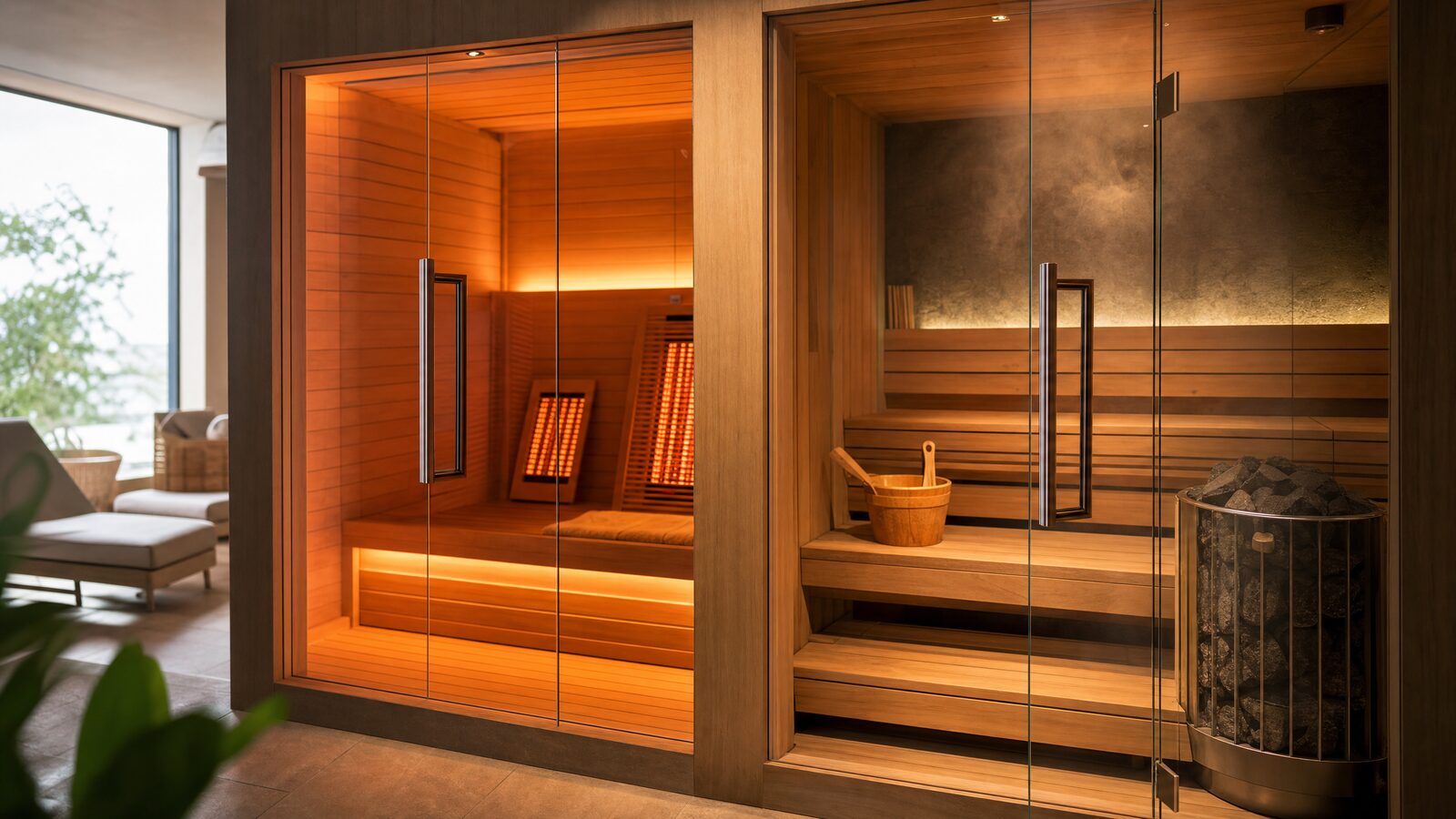
The core difference: how each one actually heats you
The simplest way to understand infrared and traditional saunas is to look at what they warm first. A traditional Finnish sauna uses a heater, usually electric or wood-fired, to warm a bed of rocks. Those rocks heat the air inside the cabin, and it is that hot air, often reaching 70 to 100C, that surrounds your body and makes you sweat. You sit inside what is essentially a very hot room, and the heat presses in on you from every direction. Many traditional saunas also let you pour water over the rocks, a practice the Finns call loyly, which sends up a burst of steam and briefly raises the humidity for a more intense, breath-catching wave of heat.
An infrared sauna works on a completely different principle. Instead of heating the air, it uses infrared lamps or panels to emit infrared energy that is absorbed directly by your skin and the tissue just beneath it. Because the heat goes into your body rather than the surrounding air, the cabin itself stays much cooler, typically around 45 to 60C. You still sweat, sometimes heavily, but the air you breathe feels far more comfortable and the sensation is drier and gentler.
That single distinction, heating the air versus heating the body, drives almost every practical difference between the two. It explains why traditional saunas feel hotter and more dramatic, why infrared feels milder and more tolerable, why one takes longer to warm up than the other, and why their running costs differ. Keep that core idea in mind and the rest of the comparison falls into place.
Temperature and how each one feels
The gap in temperature between the two is genuinely large, and it changes the whole experience. A traditional Finnish sauna commonly sits somewhere between 65 and 90C, and can climb towards 100C, which produces heavy, fast sweating and a powerful sense of enveloping heat. For people who love saunas, that intensity is the whole point. The heat is immersive, the sweat comes quickly, and a session tends to be shorter simply because the environment is so demanding.
An infrared sauna, running at around 45 to 60C, feels noticeably different. The lower air temperature makes it easier to breathe and easier to tolerate, which is why many people find they can comfortably stay in an infrared cabin longer than they could bear a traditional one. The sweat still builds, but more gradually, and the heat feels like a deep warmth rather than a wall you have to push through. For anyone who finds conventional saunas overwhelming or slightly claustrophobic, infrared is often the more approachable option.
Humidity is the other big variable. In a traditional sauna you can control the moisture by pouring water on the rocks, moving from a dry heat to a steamy, humid burst whenever you like. Infrared saunas are essentially dry heat with no steam element at all. If part of what you want from a sauna is that ritual of ladling water and feeling the loyly rise, only a traditional sauna delivers it. If you would rather avoid heavy steam and heat, infrared has the edge.
What the evidence actually says for each
This is where honesty matters most, because the two are not on equal footing when it comes to research. The traditional Finnish sauna has by far the stronger evidence base. Large, long-running Finnish cohort studies have followed thousands of regular sauna users over many years and found associations between frequent sauna bathing and a range of benefits, including lower blood pressure and better cardiovascular outcomes. Review articles in respected journals, such as Mayo Clinic Proceedings, have summarised this body of work and pointed to plausible benefits for heart health and general wellbeing.
Infrared sauna research is a much younger and thinner field. Most of what exists comes from small trials and pilot studies rather than large, long-term investigations. The early findings are promising, particularly for pain relief, exercise recovery, relaxation and some cardiovascular measures, but the studies are limited in size and duration, and it is too soon to claim the same weight of evidence that traditional sauna enjoys. Some of the benefits attributed to infrared may well hold up as research matures, but they have not yet been demonstrated at the same standard.
It is worth being clear about what this does and does not mean. The stronger evidence for traditional sauna does not prove infrared is ineffective, and it does not mean infrared has no value. It simply means that if you are making decisions based on the best available long-term outcome data, that data currently comes overwhelmingly from traditional Finnish sauna use. Both can be enjoyable and relaxing; only one has the deep research pedigree so far.
Heart and circulation
Cardiovascular effects are the headline area for sauna research, and again the traditional sauna leads the way. The Finnish cohort studies are the reason saunas are so often discussed in the context of heart health, having linked frequent bathing to reduced risk of cardiac events and lower all-cause mortality in the populations studied. The proposed mechanism is intuitive: sitting in intense heat raises your heart rate and prompts your blood vessels to dilate, producing a mild cardiovascular workout and, over time, associations with healthier blood pressure. These are observational findings rather than proof of cause and effect, but they are consistent and drawn from large numbers of people.
Infrared saunas have shown some encouraging cardiovascular signals in smaller studies, including effects on blood pressure and vascular function, and the gentler heat may make infrared more accessible for people who cannot tolerate a very hot room. That accessibility could matter, because a treatment you can actually use regularly is more useful than one you avoid. However, the infrared data remains preliminary, and it would be overstating things to say infrared delivers the same cardiovascular benefits that the large traditional-sauna studies suggest.
Whichever you choose, the cautions are the same and they are important. Heat places real demands on the cardiovascular system, so anyone with low blood pressure, an unstable heart condition or any significant cardiac history should speak to a doctor before starting, and should treat both types of sauna with respect rather than as a proven therapy. This article is general information, not medical advice, and personal circumstances vary.
Recovery, pain and relaxation
Beyond the heart, both saunas are popular for the way they help people wind down and recover. Heat encourages muscles to relax, can ease the stiffness that follows hard exercise, and provides a genuine sense of calm that many users value as much as any physical effect. If your main goal is stress relief and a warm, restorative half hour away from screens and demands, both infrared and traditional saunas do that job well, and the better choice often comes down to which heat you personally find more soothing.
Infrared has become particularly associated with recovery and pain, partly because its gentler heat lets people stay in longer and partly because several of the small studies that do exist have focused on these areas. Some people with muscle soreness, joint pain or general tension report that they find infrared comfortable and helpful. The evidence is early and modest, so it is best understood as promising rather than proven, but the low-intensity heat makes infrared an easy option to try for relaxation and post-exercise recovery.
Traditional saunas offer their own version of this, with the added dimensions of steam, ritual and often a social element. In much of the world the sauna is a shared, communal space, and that sense of occasion, of stepping out of ordinary life for a while, is part of why regular users find it so restorative. Neither approach is objectively more relaxing than the other; it depends on whether you unwind better in gentle, dry warmth or in intense, steamy heat with the option of company.
The weight-loss and detox myths
It is worth tackling two of the most common claims head on, because both saunas are frequently marketed in ways the evidence does not support. The first is weight loss. You will almost certainly weigh a little less immediately after a session, sometimes noticeably so, and this can create the impression that a sauna burns away fat. It does not. What you have lost is water through sweat, and you will regain it as soon as you rehydrate, which you should do promptly. Neither infrared nor traditional saunas are a proven weight-loss tool, and treating them as a substitute for diet and exercise sets you up for disappointment.
The second claim is detox. Marketing around infrared saunas in particular often leans heavily on the idea of sweating out toxins. In reality, the job of clearing genuinely harmful substances from your body belongs to your liver and kidneys, and sweat is overwhelmingly water and salts rather than a meaningful detox pathway. Sweating feels cleansing and is a normal, healthy response to heat, but the notion that a sauna flushes toxins in any medically significant way is not well supported.
None of this is a reason to avoid saunas. It is simply a reason to choose one for the right motivations: relaxation, recovery, the enjoyment of heat, and the cardiovascular associations that, for traditional sauna at least, have reasonable research behind them. If a provider or product is selling a sauna primarily on dramatic weight-loss or detox promises, treat those claims with healthy scepticism regardless of which type of sauna is involved.
Cost and where to use each in Ireland
Both types of sauna are readily available in Ireland, and the practical differences in access and cost can be decisive. Infrared sessions are increasingly common in dedicated wellness studios, and a single session usually costs somewhere in the region of 25 to 40 euro, with around 35 euro being typical in Dublin. Traditional and Finnish saunas turn up in a wider range of settings, including gyms, leisure centres and hotel spas, where the sauna is often included with your entry, as well as a growing number of dedicated, outdoor and mobile barrel saunas. A dedicated traditional sauna experience might cost roughly 15 to 40 euro, or nothing extra if it comes bundled with a gym or spa visit.
Running costs differ too, and this matters most if you are thinking about a home unit. Because infrared heats your body rather than a whole room and reaches a lower temperature more quickly, it generally uses less energy and warms up faster than a traditional sauna, which has to bring an entire cabin of air up to a much higher temperature and takes longer to get there. Over time and repeated use, that gap in running cost can add up.
Home options span a broad price range. Portable infrared blankets and compact cabins can start at around 200 euro and run up to roughly 1,500 euro, while fixed infrared cabins tend to fall between about 1,500 and 4,000 euro or more depending on size and quality. Traditional home saunas and outdoor barrel saunas usually sit at the higher end, often from around 3,000 to 10,000 euro or more once installed, reflecting the heavier build, the heater and the installation work involved. For many people, trying both at a local studio, gym or spa before committing to a home purchase is the sensible first step.
Which should you choose? A simple decision guide
There is no single winner here, and anyone who tells you one type is flatly better than the other is oversimplifying. The honest answer is that it depends on your heat tolerance, your budget, your available space and what you actually want from the experience. Start with heat. If you love intense, enveloping warmth, the ritual of steam and the option of a social setting, a traditional Finnish sauna is likely to suit you and comes with the strongest evidence behind it. If you find very hot rooms uncomfortable, want something gentler you can sit in for longer, or are simply new to saunas, infrared is usually the easier and more forgiving place to start.
Budget and space push the decision further. If you are buying for home and want lower upfront and running costs in a compact footprint, infrared has clear advantages, especially the affordable portable options. If you have the space, the budget and a desire for the authentic, high-heat experience, and you are drawn to the research on cardiovascular benefits, a traditional or outdoor barrel sauna may be worth the greater investment. Your goal matters too: for a broadly evidence-backed cardiovascular routine, traditional leads; for gentle recovery and relaxation you can tolerate easily, infrared is very appealing.
Whatever you choose, use it sensibly. Start with short sessions of around 10 to 15 minutes, drink plenty of water, and avoid alcohol before or during. Step out immediately if you feel dizzy, lightheaded or nauseous, and cut sessions short rather than pushing through discomfort. If you are pregnant, have low blood pressure or live with an unstable heart condition, seek medical advice before you begin. Approached with a little care, both infrared and traditional saunas can be a genuinely enjoyable part of a wider wellbeing routine, and the best one is simply the one you will actually use and look forward to.