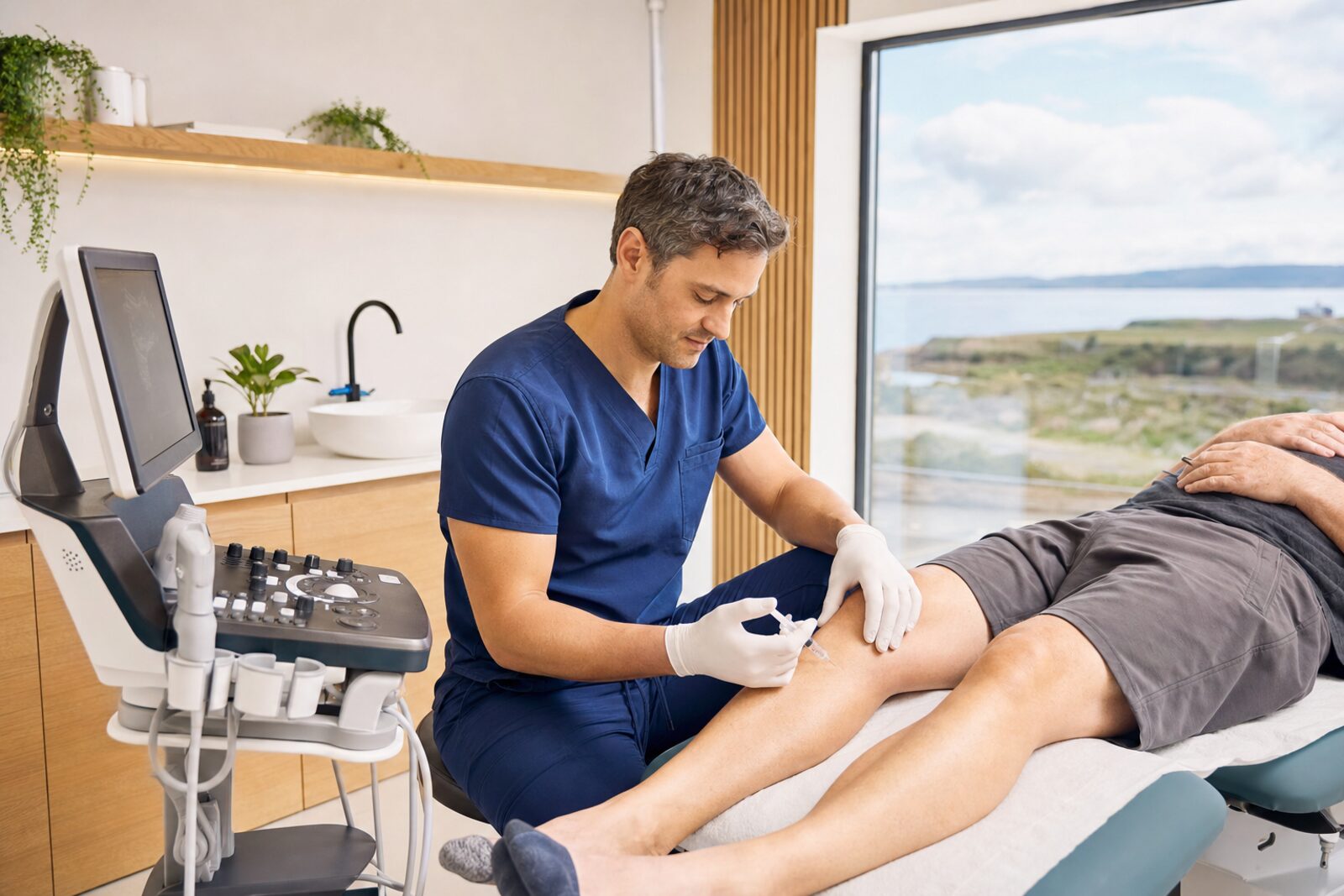
What PRP and stem cell therapy actually are
Platelet-rich plasma, or PRP, starts with a small sample of your own blood, which is spun in a centrifuge to concentrate the platelets, the blood component that releases growth factors involved in tissue repair. The concentrated platelet solution is then injected into the joint or injured tissue, where it is intended to stimulate the body's own healing response rather than replace any tissue directly.
Stem cell therapy, more precisely mesenchymal stem cell or MSC therapy, is a different biological approach. Autologous stem cells are typically harvested from the patient's own bone marrow, known as BMAC or bone marrow aspirate concentrate, or from adipose fat tissue, then concentrated and injected under imaging guidance. Some clinics also offer allogeneic stem cells, sourced from a donor rather than the patient themselves. Mesenchymal stem cells have the capacity to differentiate into several tissue types, including cartilage, bone and tendon, and are also thought to work partly through anti-inflammatory signalling rather than through direct tissue replacement alone.
The key distinction is this: PRP delivers a concentrated dose of your body's own growth factors to encourage repair, while stem cell therapy delivers cells themselves, which may differentiate, signal, or both. Both are typically walk-in, walk-out procedures performed under local anaesthesia at specialist regenerative medicine clinics.
This distinction is not just academic. It shapes how each treatment is marketed, how it is priced, and how much regulatory and clinical scrutiny it tends to attract. A PRP injection is, at its core, a concentrated dose of something already in your blood. A stem cell injection introduces living cells with the biological capacity to become other tissue types, which is a more complex intervention and one reason stem cell therapy commands a higher price in Irish clinics.
What the evidence actually shows for PRP
A 2026 systematic review and network meta-analysis in the Journal of Orthopaedic Surgery and Research pooled 18 randomised controlled trials and 1,376 participants comparing PRP alone against PRP combined with hyaluronic acid, stem cells, or ozone for knee osteoarthritis. The clearest finding was that adding hyaluronic acid to PRP produced a statistically significant extra improvement in function scores over PRP alone, while combining PRP with stem cells or ozone did not show a clear additional benefit over PRP by itself in this analysis.
This tells us two useful things. First, PRP alone has a large enough trial base, 18 randomised trials focused on this comparison, for researchers to meaningfully rank different combination strategies against each other, which is a reasonable proxy for how established the treatment has become in clinical research. Second, simply adding more expensive add-ons to a PRP injection is not automatically better, and the strongest evidence for improving on PRP alone currently points toward hyaluronic acid rather than stem cells.
What the evidence actually shows for stem cell therapy
A 2025 systematic review in the Journal of Experimental Orthopaedics focused specifically on allogeneic, donor-derived mesenchymal stem cells for knee osteoarthritis, pooling seven controlled studies. Across these studies, researchers recorded a 30.4 point improvement on the Visual Analogue Scale for pain and a 40.0 point improvement on the WOMAC osteoarthritis index at 12 months, alongside improved cartilage thickness on imaging in three of the studies. No major complications or tumour formation were reported in any of the pooled studies.
That is a genuinely encouraging result for a treatment still working to establish itself. It is also, honestly, a smaller and narrower evidence base than PRP currently has, seven studies rather than 18, focused specifically on allogeneic cells rather than the autologous, patient's-own-cells approach more commonly offered in Ireland. Autologous stem cell therapy, the type most Irish clinics provide, has less direct head-to-head trial evidence of this kind behind it than either PRP or allogeneic stem cells do, which is worth knowing before assuming the two approaches are interchangeable.
Most of the direct randomised trial evidence to date has focused on allogeneic, donor-derived MSC products, partly because they can be manufactured to a consistent standard and studied more easily than autologous cells, which vary from one patient's own bone marrow or fat tissue to the next. This is a genuine limitation for anyone comparing the marketing claims made by autologous BMAC clinics in Ireland against the specific trial evidence available, since the two are related but not identical treatments, and the evidence for one does not automatically transfer to the other.
The gap between the hype and the evidence
A 2026 systematic review in the Orthopaedic Journal of Sports Medicine took a genuinely useful extra step: alongside reviewing the trial evidence for PRP, stem cells and a third orthobiologic called autologous protein solution, the researchers also reviewed how these treatments were covered in the news media. Of 14 randomised controlled trials that compared an injectable orthobiologic against a placebo injection for knee osteoarthritis, 8 showed a significant improvement in pain and 10 showed a significant improvement in function, but heterogeneity between studies and risk of bias were frequent problems across the trial set.
The media side of the same review found a striking disconnect. Of 124 relevant news articles reviewed, 79.0 per cent highlighted therapeutic benefits while only 29.8 per cent mentioned any drawbacks, 66.1 per cent were favourable in overall tone, and 37.1 per cent used the term stem cell without specifying which actual product or procedure was involved. Commercial entities were mentioned in over a third of the articles with no corresponding disclosure of that relationship.
This matters for anyone researching these treatments online. The trial evidence for both PRP and stem cell therapy is genuinely mixed, encouraging in places, inconsistent in others, and still accumulating. Public discussion of these treatments tends to be considerably more confident than the underlying research supports.
The researchers behind this review suggested the disconnect happens because injectable orthobiologics make for an appealing story: a patient's own body used to heal itself, with dramatic before-and-after testimonials that are easy to write about and hard to independently verify. A systematic review of trial data is a much less compelling headline than an individual patient's recovery story, even when the trial data is what should actually guide a treatment decision.
Cost in Ireland: PRP vs stem cell therapy
PRP for joint conditions such as knee osteoarthritis or tendon injuries in Ireland typically costs 500 to 1,200 euro per session, and most protocols involve an initial course of three to four sessions spaced four to six weeks apart. Stem cell therapy sits considerably higher, with a course typically running 1,500 to 4,500 euro depending on the complexity of the case, the imaging used, and the aftercare included.
Neither treatment is covered by public healthcare or most private health insurance in Ireland, since both are still considered non-standard interventions rather than established first-line care. Reputable clinics should offer a consultation with transparent, itemised pricing before you commit to a course of either treatment, rather than a single headline figure that leaves out imaging, follow-up visits and any additional sessions.
Prices last checked August 2026 and can vary between clinics; always confirm current pricing directly before booking.
Who tends to be offered which treatment
In practice, PRP is more often positioned as an earlier, less expensive option, used for tendon injuries and mild to moderate joint degeneration, partly because the evidence base behind it is broader and partly because the cost is considerably lower. Stem cell therapy tends to be discussed for more advanced joint degeneration, or for patients who have already tried PRP without the improvement they hoped for, reflecting both its higher cost and clinicians' sense that it may offer something different mechanistically.
In Ireland, both treatments are generally offered by the same specialist regenerative medicine clinics, concentrated in Dublin, rather than by separate categories of provider. This means the practical choice for most patients comes down to a conversation with a specific clinic about your particular joint, your imaging findings, and what they believe is a reasonable next step, rather than a fixed rule about which treatment suits which condition.
This is different from how many surgical pathways work, where a specific diagnosis tends to map onto a fairly standard treatment protocol. Regenerative medicine in Ireland is still young enough, and the trial evidence still developing enough, that reasonable clinicians can and do disagree about which patients are the best candidates for which treatment. That makes it more important, not less, for a patient to ask what the specific evidence is for their situation rather than assuming either treatment is a default choice.
Safety and what to ask before you book
Autologous PRP and autologous stem cell therapy both use material drawn from your own body, which keeps the risk of rejection or allergic reaction low compared with a foreign substance. Both are still invasive procedures involving a needle into a joint, and carry the ordinary risks that come with any injection, including infection, bruising, and a temporary flare in pain before any improvement begins.
Before booking either treatment, it is worth asking a clinic several direct questions: whether the cells or plasma are autologous or donor-derived, whether the injection will be performed under ultrasound or another imaging guidance, what qualifications and specific experience the practitioner has with this exact procedure, and what proper diagnostic imaging of your joint has been done before treatment is recommended. A responsible clinic should welcome these questions rather than treat them as an inconvenience.
What recovery and timeline actually look like
PRP recovery is typically straightforward. Most people experience some soreness at the injection site for a day or two, can return to normal activity within a few days, and are advised to avoid anti-inflammatory medication around the time of injection, since it may blunt the very inflammatory response PRP is designed to trigger. Meaningful improvement, when it occurs, is usually reported over four to eight weeks following a completed course.
Stem cell therapy follows a slower, longer arc. Clinics typically describe continued improvement over six to twelve months as the injected cells integrate and any tissue regeneration takes effect, considerably longer than the PRP timeline. This longer horizon is itself a reason to be cautious about early judgements on either side, a person who has not improved by six weeks after stem cell therapy has not necessarily had a failed treatment, but it is also a reason the higher price tag deserves careful thought before committing.
The bottom line
Neither PRP nor stem cell therapy currently has the kind of large, consistent, high-certainty trial evidence behind it that would let anyone say definitively which works better for joint pain. PRP has the broader trial base and the lower price. Stem cell therapy, particularly the allogeneic form studied most directly, has shown encouraging 12 month outcomes in a smaller number of controlled studies, at a meaningfully higher cost.
For anyone in Ireland weighing the two, the honest starting point is a proper diagnosis from an orthopaedic specialist or your GP, not a marketing page. A regenerative medicine clinic can be a reasonable next step once you understand what condition you are actually treating and what surgery or other options remain on the table, but it should sit alongside that medical assessment, not replace it.