What this meta-analysis actually looked at
Whole-body cryotherapy has been marketed for years as a way to reduce inflammation, and a research team based in China set out to test whether the claim holds up against the actual trial evidence. Published in Scientific Reports in March 2025, the study searched PubMed, Web of Science, Embase and the Cochrane Library for randomised controlled trials that measured inflammatory markers in people exposed to whole-body cryotherapy, up to August 2024. Eleven trials met their criteria, together enrolling 274 participants.
The researchers did not simply average the raw numbers from each trial. They used the PEDro scale to assess the risk of bias in each included study, and the GRADE framework, the same system used across serious medicine, to grade how much confidence the pooled result deserves once bias, inconsistency between studies, and imprecision are accounted for. The analysis itself was run in RevMan, the software the Cochrane Collaboration uses for its own systematic reviews.
This matters because a lot of what gets written about cryotherapy and inflammation cites single small studies or animal work. This is neither. It is a deliberate attempt to combine everything decent that has been published on real people, and to be honest about how much weight the combined result can bear.
Whole-body cryotherapy chambers have been part of elite sports recovery since the 1990s, and their use has since spread into general wellness and longevity clinics, often with confident claims attached about detoxification, immune boosting and anti-ageing effects that go well beyond what any trial has tested. This meta-analysis narrows the question down to something that can actually be measured with a blood sample, whether cryotherapy changes circulating inflammatory markers, and answers only that narrower question.
What the researchers found: lower IL-1 beta, higher IL-10
The meta-analysis focused on two specific markers circulating in blood. IL-1 beta is a signalling protein that drives inflammation, and elevated levels are associated with joint pain, tissue damage and the general inflammatory load the body is carrying. IL-10 works in the opposite direction, damping down inflammatory signalling once it has done its job. A treatment that lowers IL-1 beta and raises IL-10 is, in principle, shifting the body toward a less inflamed state.
Across the 11 pooled trials, people exposed to whole-body cryotherapy had measurably lower IL-1 beta and measurably higher IL-10 than people in the comparison group who were not exposed. The effect sizes were reported as standardised mean differences, a statistical tool that lets researchers combine results from studies using different assays and units, rather than as a raw percentage change, and both differences reached statistical significance.
The pattern was not identical across every kind of participant. Athletes showed the clearest fall in IL-1 beta, consistent with cryotherapy's long-standing use in sports recovery. People with obesity showed the clearest rise in IL-10, which fits with the idea that cryotherapy's anti-inflammatory effect may be more noticeable in people who are carrying more baseline inflammation to begin with. The authors were careful to present this as a pattern worth investigating further, not as a settled finding about who benefits most.
Why this counts as promising, not proven
It is worth being precise about what was actually measured here. IL-1 beta and IL-10 are biomarkers, chemical signals in blood that correlate with inflammation, not a person's actual experience of pain, stiffness, or joint function. A treatment can shift a biomarker in the right direction without that shift translating into something a patient with, say, rheumatoid arthritis or knee osteoarthritis would notice day to day. The meta-analysis did not track clinical outcomes like pain scores, disease activity, or quality of life in a diagnosed patient group, because none of the 11 underlying trials were designed to.
There is also a structural limitation that no meta-analysis of cryotherapy can fully escape. Because whole-body cryotherapy is impossible to disguise, a person stepping into a chamber cooled to minus 110C obviously knows they are not in a control group, none of the 11 randomised controlled trials pooled here could be blinded in the way a drug trial can be, where neither patient nor researcher knows who received the active treatment. The randomisation itself is still valuable, because it spreads other differences between participants evenly across groups, but the lack of blinding means expectation effects cannot be fully ruled out for anything that relies on self-report, even though blood biomarkers are less susceptible to a placebo response than pain scales are.
The study authors themselves flagged the main limitation plainly: eleven trials is not a large evidence base, several of the included studies had small sample sizes, and they called for larger randomised controlled trials to confirm and extend the finding. That is exactly the kind of honest caveat that should travel with this result whenever it gets cited.
A second study, a different angle: pain thresholds after one session
A separate 2025 trial, published in the European Journal of Pain by a team at the University of Wuppertal in Germany, tested a related but distinct question: does a single cryotherapy session change how much pain a person can tolerate. Twenty-four healthy men each completed one three-minute session in a cryochamber cooled to minus 87C and one session at ordinary room temperature, in random order, a randomised controlled cross-over design where each participant acts as their own comparison.
Pressure pain thresholds, essentially how much mechanical pressure it takes before a spot starts to hurt, were measured at four body sites before each session and again at several points afterwards. Following the cold exposure, pain thresholds rose significantly, meaning it took more pressure to trigger discomfort, an effect the researchers call cryo-induced hypoalgesia. The effect was strongest immediately after the session and gradually declined over the following 30 minutes. The room-temperature control session produced no change at all.
As with the meta-analysis, the honest caveats matter. This was 24 healthy young men, not a clinical population with a diagnosed pain condition, it measured a single acute exposure rather than a repeated course, and because participants could obviously tell which session was the cold one, it could not be blinded either. What it adds to the picture is a plausible short-term mechanism, a genuine, measurable, if temporary, increase in pain threshold, that sits alongside the longer-term biomarker shifts the meta-analysis found.
What whole-body cryotherapy is and how Irish clinics offer it
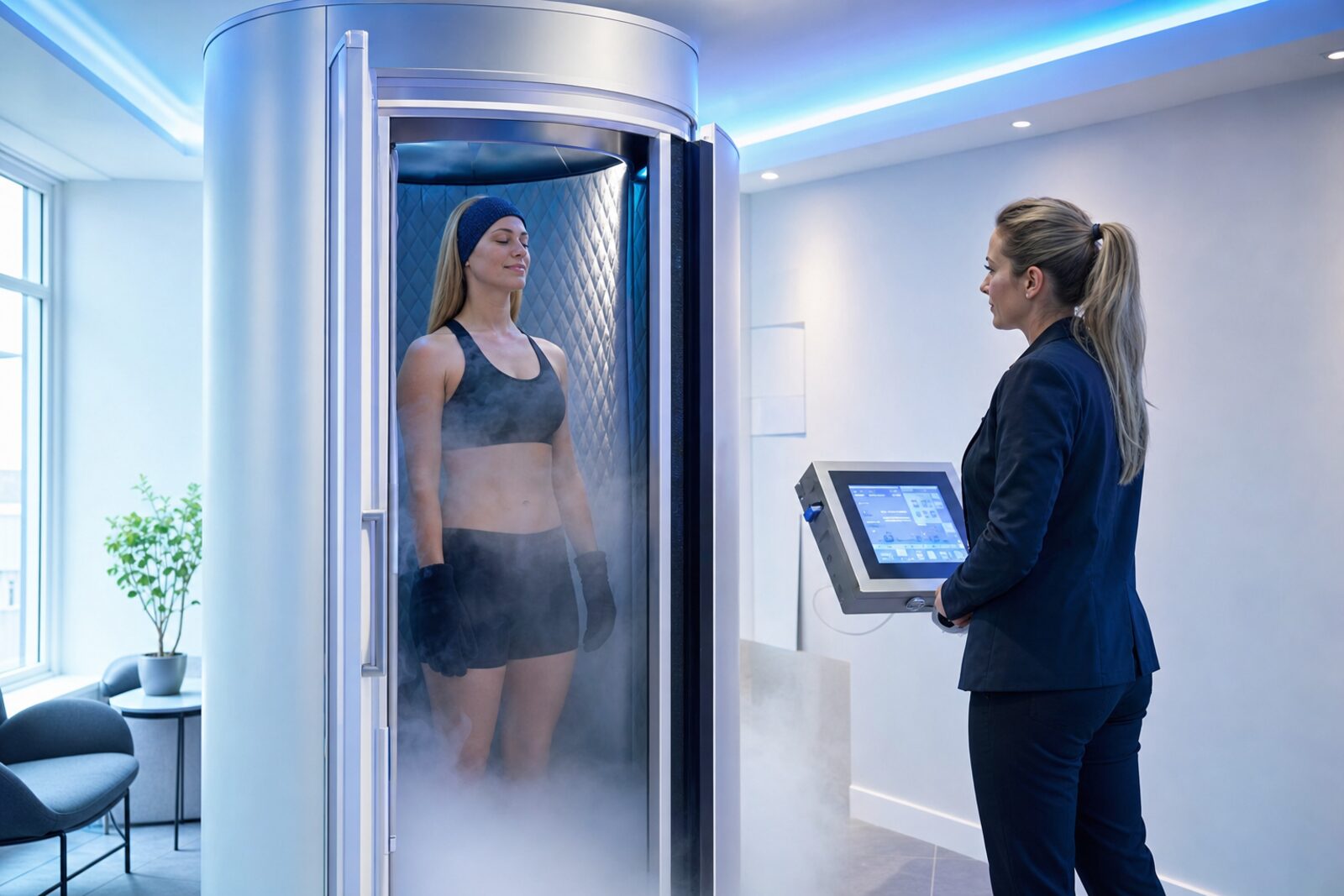
Whole-body cryotherapy exposes the body to extremely low temperatures, typically between minus 110C and minus 140C, for two to three minutes at a time, using either electric or nitrogen-cooled chambers. The exposure triggers vasoconstriction followed by vasodilation once the session ends, along with a burst of endorphin release and the inflammatory signalling changes described above. Localised cryotherapy devices, which target a single joint or muscle group rather than the whole body, are also widely available and tend to cost less per session.
In Ireland, whole-body cryotherapy is offered by clinics across Dublin, Belfast, Cork, Galway and Kilkenny, often alongside complementary recovery treatments such as infrared sauna and compression therapy. It is generally offered as a wellness and recovery service rather than a medically prescribed treatment, which means it sits outside the kind of regulatory oversight that applies to registered medicines in Ireland.
Most Irish providers recommend an initial block of sessions, often five to ten visits over two to three weeks, before assessing whether someone wants to continue with occasional maintenance sessions. This mirrors the repeated-exposure protocols used in several of the trials pooled in the meta-analysis, though the exact number and spacing of sessions varied considerably between the individual studies, and no single protocol has been established as optimal.
Who might reasonably consider it, and who should be cautious
Given the evidence so far, whole-body cryotherapy is most defensible as a recovery aid for athletes and active people managing normal post-exercise inflammation and soreness, where the biomarker evidence and the short-term pain threshold evidence both point in a consistent, if modest, direction. It is not, on current evidence, a substitute for medical treatment of a diagnosed inflammatory or autoimmune condition, and anyone with such a diagnosis should discuss cryotherapy with their treating doctor before adding it to their routine, rather than using it in place of prescribed treatment.
Cryotherapy chambers are not suitable for everyone. Standard contraindications applied by reputable clinics include uncontrolled high blood pressure and cardiovascular disease, Raynaud's phenomenon and other conditions involving abnormal sensitivity to cold, pregnancy, open wounds or skin infections, and severe claustrophobia. A responsible clinic will run through a health questionnaire before a first session and should be willing to say plainly when cryotherapy is not appropriate for a particular person, rather than treating it as suitable for everyone.
What it costs in Ireland, weighed against what the evidence shows
A single whole-body cryotherapy session in Ireland typically costs between 50 and 100 euro, with multi-session packages of five to ten visits often bringing the per-session price down to somewhere around 40 to 60 euro. Localised cryotherapy targeting a single area is usually cheaper again, often in the region of 30 to 60 euro per session.
Set against the evidence covered here, that price feels proportionate for what cryotherapy currently is: a low-risk recovery and wellness practice with a real, replicated, if modest, anti-inflammatory signal in blood and a genuine short-term pain-threshold effect. It is not, on the current evidence, worth paying for as a treatment for a specific diagnosed disease, because no trial has yet tested it that way.
Prices last checked August 2026 and can vary between clinics; always confirm current pricing directly before booking.
The bottom line
Eleven randomised controlled trials, pooled carefully and graded honestly, show that whole-body cryotherapy produces a real, consistent shift in inflammatory blood markers, lower IL-1 beta and higher IL-10, with the size of the benefit varying by who is being treated. A separate trial adds a genuine, if short-lived, increase in pain threshold after a single session. Taken together, this is a promising evidence base for cryotherapy as a recovery tool, not proof that it treats any specific inflammatory disease.
The researchers behind the meta-analysis were careful to frame their own findings as a foundation for further work rather than a final answer, and that is the right way to read this evidence in Ireland too. If you are an athlete or an active person using cryotherapy for recovery, the biomarker and pain-threshold evidence gives you a reasonable, evidence-based reason to continue. If you are considering it as a treatment for a diagnosed inflammatory condition, the honest answer is that the trials simply have not tested that yet, and your GP or specialist remains the right first call.