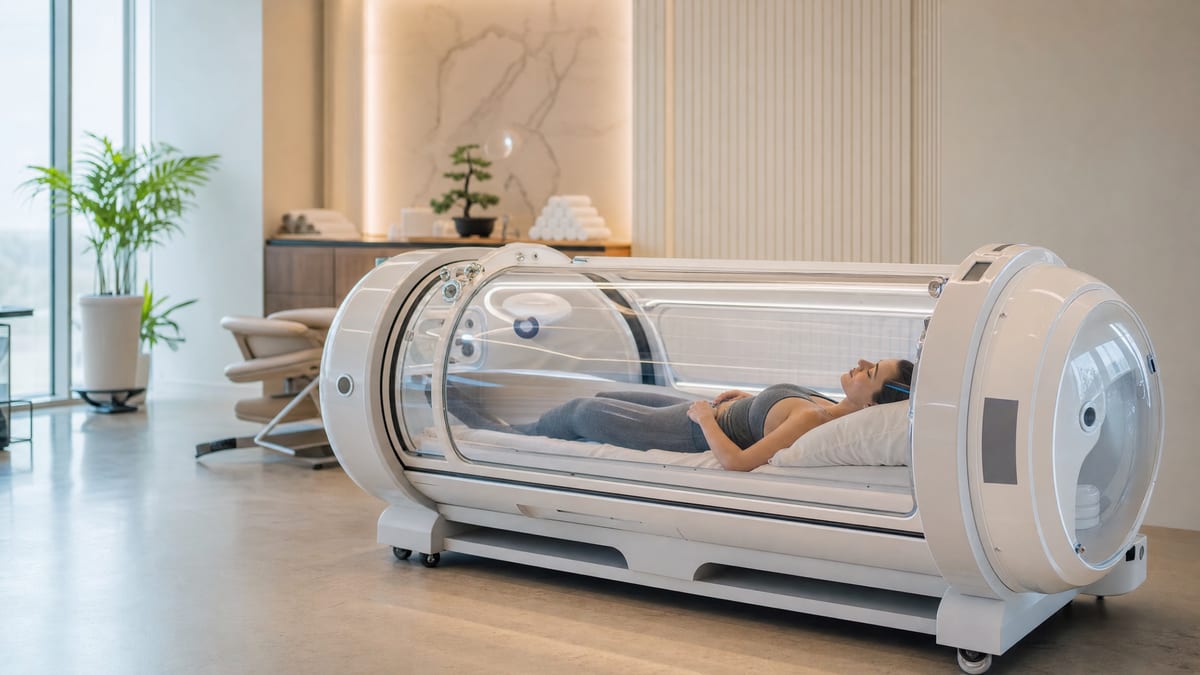
The headline result: HBOT did not beat placebo for Long COVID
Two independent randomised controlled trials published in 2025 have tested whether hyperbaric oxygen therapy helps people with Long COVID, and both reached the same conclusion: it does not. In the Belgian trial, led by D'hoore and colleagues at the Queen Astrid Military Hospital in Brussels, 101 patients were randomised into four groups receiving different oxygen doses, including a true placebo arm breathing ordinary room air at normal pressure. In the Swedish trial, led by Kjellberg and colleagues at the Karolinska University Hospital in Stockholm, 80 previously healthy adults with Long COVID received either genuine HBOT or a sham treatment designed to feel like the real thing. Neither trial found any significant difference between HBOT and placebo on any of their primary outcome measures.
This is a negative result, and negative results are some of the most valuable findings in medicine. They protect people from spending time, money, and hope on treatments that do not work. For anyone in Ireland who has been considering HBOT as a way to recover from Long COVID, or who has already been quoted hundreds or thousands of euro for a course of sessions, this evidence deserves careful attention. It does not mean HBOT is useless for everything, but it does mean that the specific claim that HBOT helps Long COVID is not supported by the best available evidence.
The fact that two entirely independent research groups, working in different countries with different patient populations and different protocols, arrived at the same negative conclusion makes this finding considerably more robust than any single trial could be on its own. When two well-designed studies agree, especially on a null result, the scientific community takes notice.
Why these trials matter more than earlier studies
You may have seen headlines over the past few years suggesting that HBOT shows promise for Long COVID. Some of those reports were based on real studies, but the critical difference is in study design. Most of the earlier research lacked a proper placebo control. In a condition like Long COVID, where symptoms fluctuate naturally and where the experience of lying in a pressurised chamber for ninety minutes is itself unusual and attention-laden, the absence of a placebo group makes it impossible to know whether improvements were caused by the oxygen or by the passage of time, the ritual of treatment, and the expectation of getting better.
A double-blind, placebo-controlled randomised controlled trial is the gold standard in clinical research precisely because it addresses this problem. In a double-blind trial, neither the patient nor the treating clinician knows who is receiving the real treatment and who is receiving the sham. This eliminates, as far as possible, the influence of expectations on both sides. The randomisation ensures that the two groups are comparable at the start, so any difference in outcomes can be attributed to the treatment rather than to differences between the patients. When a treatment fails to outperform a well-designed placebo in this kind of trial, it is strong evidence that the treatment itself is not doing what was hoped.
Both the Belgian and Swedish trials met this standard. The Belgian study was particularly rigorous in its design, using four separate arms that allowed the researchers to test different oxygen doses and pressures against a true placebo of room air at normal atmospheric pressure. The Swedish trial, published in BMJ Open, used medical air delivered at a slightly elevated pressure as its sham, creating a convincing placebo experience that patients could not easily distinguish from genuine HBOT. Both trials were prospectively registered, clearly reported, and free of industry funding.
How the Belgian trial was designed and what it found
The Belgian trial, published in Diving and Hyperbaric Medicine in June 2025, randomised 101 Long COVID patients into four groups. Group A received standard HBOT: 100 per cent oxygen at 2.5 atmospheres absolute, the protocol most commonly used in clinical HBOT. Group B received 40 per cent oxygen at the same pressure. Group C received 100 per cent oxygen but at normal atmospheric pressure, a normobaric condition that tests whether the oxygen itself, rather than the pressure, might be the active ingredient. And Group D, the true placebo arm, received ordinary room air at normal pressure, meaning 21 per cent oxygen at 1.0 atmosphere. Each group received ten sessions.
The researchers measured outcomes across a broad range of instruments: quality of life scores using the VAS, EQ-5D-5L, and the COVID-19 Yorkshire Rehabilitation Scale, a six-minute walking test, and five separate neurocognitive tests. This breadth of measurement is important because it means the study was not looking at only one narrow endpoint that might miss a real effect. If HBOT helped Long COVID in any measurable way, whether through improved energy, better cognition, greater physical capacity, or subjective wellbeing, these instruments had a reasonable chance of detecting it.
The result was unequivocal. There were no significant differences between any of the four groups on any outcome measure. Notably, some patients in the placebo group reported meaningful improvements in their symptoms, a finding that the researchers highlighted as evidence for a substantial placebo effect in Long COVID treatment. The authors concluded plainly that there was no significant effect from different doses of oxygen in a hyperbaric chamber, and that the modest improvements reported in some earlier studies may well have been due to the placebo response rather than to any genuine therapeutic effect of HBOT.
How the Swedish trial was designed and what it found
The Swedish trial, known as HOT-LoCO, was published in BMJ Open in April 2025. It enrolled 80 previously healthy adults aged 18 to 60 who had developed Long COVID. Participants were randomised to receive either ten sessions of genuine HBOT, breathing 100 per cent oxygen at 2.4 bar for ninety minutes, or a sham treatment using medical air at a lower pressure designed to mimic the sensory experience of being in a hyperbaric chamber without delivering a therapeutic oxygen dose. The sham pressure started at 1.34 bar and was reduced to 1.2 bar during the session, creating enough of a pressure sensation for patients to believe they might be receiving the real treatment.
The primary endpoints were physical functioning and role limitations due to physical health, measured using the RAND-36 questionnaire at thirteen weeks. These are well-validated, widely used measures of how a condition affects a person's daily life, and they capture exactly the kind of functional improvement that someone with Long COVID would hope to get from treatment. Secondary outcomes included additional RAND-36 domains, symptom severity, and adverse events.
Both groups improved over the course of the study, but the improvements were statistically indistinguishable between the HBOT and sham arms. The p-values for the primary outcomes were 0.87 for physical functioning and 0.57 for role limitations, meaning there was no meaningful signal of benefit whatsoever. The researchers did observe a sex difference in outcomes, with men and women responding differently on some measures, but crucially there was no treatment difference. Adverse events were similar in both groups, occurring in 49 per cent of HBOT patients and 44 per cent of those receiving sham treatment. The trial was funded by the Swedish Research Council, Region Stockholm, and the Heart-Lung Foundation, with no industry involvement.
The placebo effect and why both groups got better
One of the most striking findings from both trials is that patients improved regardless of whether they received real HBOT or a sham treatment. This is not unusual in Long COVID research, and it points to several overlapping factors that are important for anyone evaluating treatments for this condition.
First, Long COVID symptoms naturally fluctuate and, for many patients, gradually improve over time. Any study that enrols patients during a particularly symptomatic period will tend to see improvement simply because of regression to the mean, the statistical tendency for extreme values to move back towards the average. Second, the placebo effect in conditions characterised by subjective symptoms like fatigue, brain fog, and pain is well documented and often substantial. The experience of receiving what you believe to be a sophisticated medical treatment, in a clinical environment, with professional attention and a structured routine, can genuinely change how people perceive and report their symptoms. Third, the act of participating in a clinical trial itself may confer benefits through increased medical attention, regular check-ups, and the psychological comfort of doing something active about one's condition.
This does not mean that the improvements patients experienced were not real to them. They were. But it does mean that the improvements cannot be attributed to the HBOT itself, because the same improvements occurred in people who received no therapeutic oxygen at all. This is precisely why placebo-controlled trials exist: to distinguish treatments that work from treatments that merely feel like they work. For Long COVID, these two trials suggest that HBOT falls into the latter category.
What HBOT is genuinely established to treat
It is important to be fair to HBOT as a therapy. The negative findings for Long COVID do not diminish the genuine, well-established evidence for HBOT in its recognised medical indications. Decompression sickness, the injury sustained by divers who surface too quickly, remains the original and most clear-cut use case. Carbon monoxide poisoning, gas gangrene, certain non-healing diabetic foot ulcers, delayed radiation injury, compromised skin grafts, and several other serious conditions are all treated with HBOT in hospital settings around the world, supported by decades of clinical evidence.
In Ireland, the HSE hyperbaric unit at University Hospital Galway provides medical HBOT for these recognised indications. This is a different world from the wellness and longevity clinics that offer HBOT for conditions like Long COVID, sports recovery, or general wellbeing. The pressures used, the clinical oversight, the patient selection, and the evidence base are all fundamentally different. When we say HBOT did not work for Long COVID, we are making a specific statement about one particular application, not a general dismissal of a therapy that saves lives and limbs in its proven uses.
The distinction matters because rejecting HBOT entirely on the basis of these Long COVID results would be as much of an error as embracing it uncritically for every condition. Good evidence-based medicine means following the data condition by condition, and the data here are clear: HBOT works for decompression sickness, it works for non-healing wounds, and it does not appear to work for Long COVID.
What this means for people in Ireland considering HBOT for Long COVID
A ten-session course of HBOT at a private clinic in Ireland typically costs between €800 and €2,000, depending on the provider, the type of chamber, and the protocol used. Several private clinics around the country have marketed HBOT as a potential treatment for Long COVID recovery, and it is understandable that people struggling with persistent symptoms would be drawn to any therapy that offers hope. Long COVID can be debilitating, frustrating, and isolating, and the conventional medical system has been slow to offer effective treatments.
However, these two trials present evidence that the money spent on HBOT for Long COVID is unlikely to deliver results beyond what you would experience from a convincing placebo. That is a meaningful finding for anyone weighing their options, because €800 to €2,000 is not a trivial sum, and it could be directed towards other forms of rehabilitation and support that may genuinely help. Structured exercise programmes, cognitive rehabilitation, pacing strategies guided by occupational therapy, and psychological support for the burden of chronic illness all have evidence behind them for post-viral recovery, even if none represents a cure.
If you have already undergone HBOT for Long COVID and felt that it helped, these trial results do not invalidate your experience. What they suggest is that the improvement you felt was most likely driven by the passage of time, the placebo response, or the structured routine of attending treatment sessions, rather than by the oxygen therapy itself. That is not a criticism of you or your experience; it is simply what the controlled evidence shows when the placebo effect is properly accounted for.
Earlier studies and why they told a different story
If HBOT does not work for Long COVID, why did some earlier studies suggest it might? The answer lies almost entirely in study design. Several of the earlier trials that produced positive-looking results were either unblinded, meaning patients knew whether they were receiving HBOT or not, or lacked a true placebo control, or were very small in size. In a condition like Long COVID, where subjective symptoms dominate and where the placebo effect is powerful, these design weaknesses can easily create the appearance of a benefit that is not really there.
One widely cited earlier trial, for example, compared HBOT to no treatment at all rather than to a sham. Patients who received HBOT knew they were getting the active therapy, and patients who received nothing knew they were in the control group. Under these conditions, it would be surprising if the treated group did not report feeling better, because the expectation of benefit alone is often enough to shift subjective symptom scores. The two 2025 trials corrected for this by using carefully designed sham treatments that patients could not reliably distinguish from the real thing, and under those conditions the apparent benefit disappeared.
This is a common pattern in medicine and not unique to HBOT. Treatments frequently look promising in early, uncontrolled research and then fail to hold up when tested in properly blinded, placebo-controlled trials. It is not evidence of fraud or bad faith on the part of earlier researchers; it is simply the natural consequence of testing a hypothesis with progressively more rigorous methods. The 2025 trials represent the current best evidence, and they supersede the weaker, earlier findings.
Where the research goes from here
These two trials do not necessarily close the book on HBOT and Long COVID entirely, but they do set a high bar for anyone arguing that the treatment works. Future research might explore whether specific subgroups of Long COVID patients respond differently, whether different HBOT protocols involving more sessions or higher pressures might produce different results, or whether HBOT combined with other interventions might have synergistic effects. The Belgian trial examined subgroups and found no population that responded better to any treatment arm, which is discouraging for the subgroup hypothesis, but larger studies might yet identify a responsive subset.
More broadly, Long COVID research continues at pace, and the hope is that effective treatments will emerge from the many other avenues being investigated, including antiviral therapies, immune-modulating drugs, and targeted rehabilitation programmes. The negative HBOT result is, in a sense, part of the normal scientific process of testing hypotheses and discarding the ones that do not hold up, which is how medicine eventually arrives at treatments that genuinely work.
For now, the practical message for people in Ireland with Long COVID is to be guided by the evidence as it stands. HBOT for Long COVID is not supported by the best available trials. The money and time involved in a course of treatment are substantial, and the evidence suggests they would not buy you a benefit beyond placebo. If new, higher-quality evidence emerges in the future that changes this picture, we will update this article accordingly. Until then, the honest assessment is that HBOT is not the answer for Long COVID, however much we might wish it were.