What the review actually looked at
Total knee and total hip replacement are two of the most common planned surgeries carried out in Ireland, effective at relieving chronic joint pain and restoring mobility, but the weeks that follow surgery are rarely comfortable. Pain, swelling, restricted range of motion, and muscle weakness are all expected parts of recovery, and structured physiotherapy is the established way to work through them. A 2026 systematic review, published in the journal Photobiomodulation, Photomedicine, and Laser Surgery, asked a specific question: does adding photobiomodulation therapy, more commonly known as red or near-infrared light therapy, to standard rehabilitation actually improve those outcomes.
The research team, based at universities in Saudi Arabia and Egypt, searched PubMed, ProQuest, ScienceDirect, and Google Scholar from inception through May 2025, looking specifically for prospective controlled trials that measured photobiomodulation's effect on postoperative pain, swelling, range of motion, or functional performance after knee or hip replacement. Case reports, uncontrolled studies, and trials measuring unrelated outcomes were excluded, and the review protocol was registered in advance with PROSPERO, the international register of systematic reviews, which is a marker of methodological transparency because it commits researchers to their planned approach before they see the results.
Four trials, involving 133 patients in total, met the inclusion criteria: three focused on total knee arthroplasty and one on total hip arthroplasty. That is a modest evidence base by the standards of a mature medical question, and the review's own authors are upfront about that limitation throughout their conclusions.
What the four trials found
Across the four included trials, photobiomodulation therapy significantly improved postoperative pain and reduced swelling compared with placebo light or standard care alone in three of the studies. Two of the trials also found improvements in range of motion and broader functional performance, meaning patients receiving PBMT alongside their normal rehabilitation tended to move better and report better function than those receiving standard care alone.
The reviewers assessed methodological quality using the PEDro scale, a widely used tool for rating the rigour of physiotherapy trials on a ten-point scale covering things like randomisation, blinding, and completeness of reporting. The four included trials scored between 8 and 10, which the review authors characterised as moderate-to-high quality. That is a genuinely encouraging quality signal: this was not a review built on weak or poorly conducted studies, and the consistency of the positive findings across pain and swelling outcomes in particular is worth taking seriously.
What the review is careful not to claim is that photobiomodulation changes the ultimate outcome of joint replacement surgery, such as long-term implant function or the need for revision surgery. The trials it pooled were measuring short-term rehabilitation markers, pain, swelling, movement, and function, in the weeks immediately following surgery, not years-long outcomes.
Why the reviewers stopped short of calling this settled
Despite the encouraging pattern across three of the four trials, the review's conclusion is carefully hedged: photobiomodulation shows promising short-term benefits, but due to heterogeneity in treatment parameters and a limited number of high-quality trials, conclusive evidence remains insufficient. This is worth taking at face value rather than rounding up to a stronger claim, because it reflects a real methodological problem, not excessive caution.
Heterogeneity in treatment parameters means the four trials did not all use the same wavelength, dose, treatment duration, or number of sessions, which makes it harder to say with confidence exactly what protocol produces the benefit, or whether a different protocol might produce a larger or smaller effect. When trials measuring the same broad question use meaningfully different methods, pooling their results tells you a direction is plausible without telling you the precise recipe that works best.
The small total sample size, 133 patients across four trials, is the other core limitation. That is enough to detect a reasonably sized effect on pain and swelling, which is what the review found, but it is not enough to rule out smaller effects being wrong, to properly assess less common outcomes, or to break results down by patient subgroups such as age, sex, or the specific joint involved. The review's own call for future large-scale, standardised RCTs with longer follow-up is the correct scientific response to this evidence: not dismissal, and not overclaiming, but a clear statement of what would be needed to move from promising to established.
How photobiomodulation is thought to work
Photobiomodulation uses specific wavelengths of red (roughly 620 to 700 nanometres) and near-infrared (roughly 700 to 1,100 nanometres) light, delivered by LED panels or low-level lasers, to penetrate skin and superficial tissue. The proposed mechanism centres on cytochrome c oxidase, an enzyme in the mitochondria of cells, which absorbs light at these wavelengths and responds by increasing ATP production, the basic energy currency cells use to function and repair themselves.
In the context of postoperative recovery, the theory is that this boost in cellular energy production supports faster tissue repair, helps modulate the inflammatory response that drives swelling, and may reduce pain signalling at a local level. This is a biologically plausible mechanism supported by laboratory and cell-level research, and it is consistent with the pattern of results seen across other applications of photobiomodulation for musculoskeletal pain and soft-tissue healing.
It is worth being precise about what this explains and what it does not. The mechanism gives a reasonable biological story for why light therapy might help, but a plausible mechanism is not the same as proof of clinical benefit; that has to come from trials measuring real outcomes in real patients, which is exactly what this review set out to assess.
What this looks like in an Irish rehabilitation setting
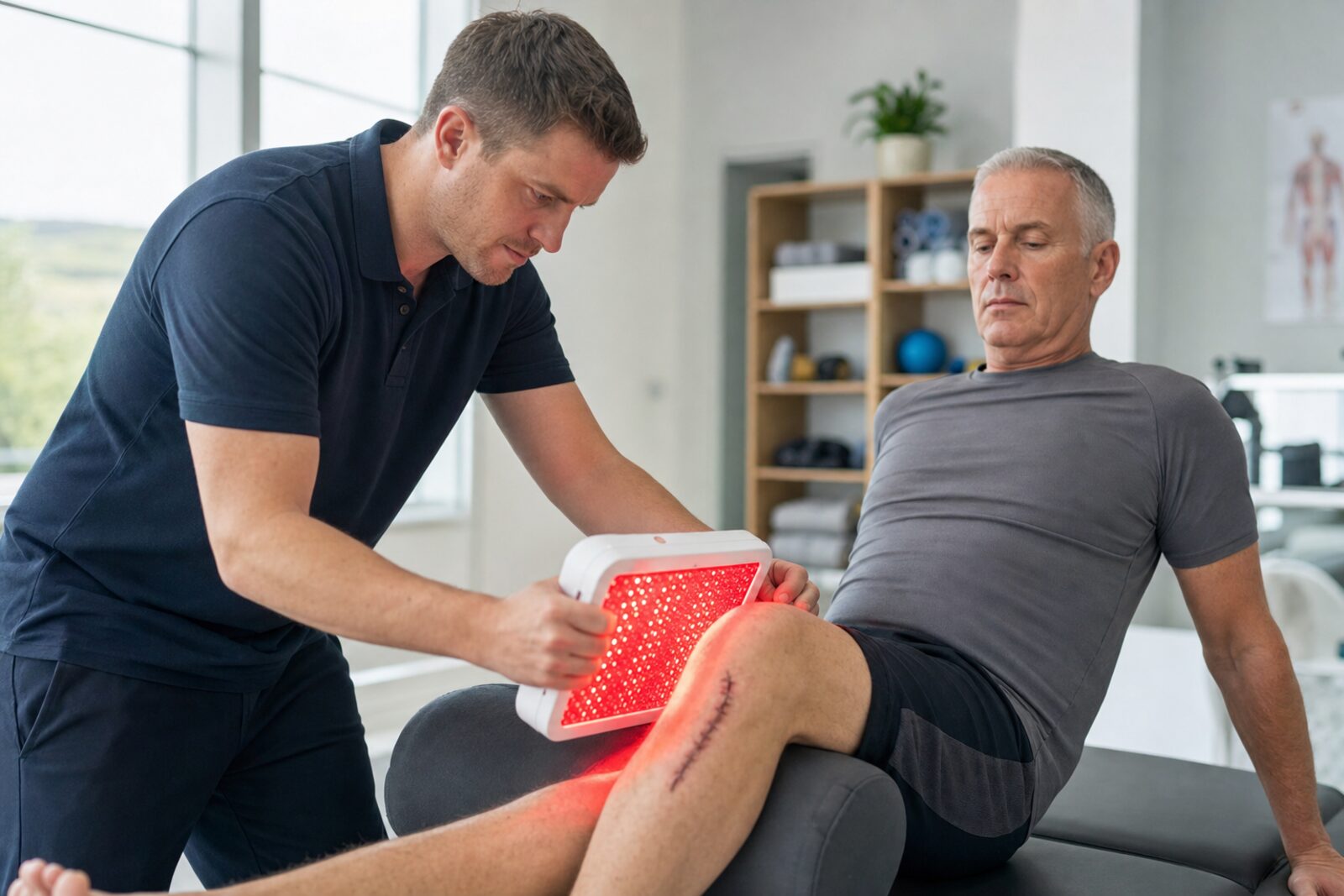
Total knee and hip replacements are common procedures within the Irish public and private hospital systems, and standard rehabilitation follows a well-established physiotherapy pathway: early mobilisation, a structured exercise programme, and staged goals for range of motion and weight-bearing over the weeks after surgery. Photobiomodulation, where it is used, is generally offered as an add-on within a physiotherapy clinic or a dedicated recovery and biohacking clinic, applied to the operated joint over a course of sessions rather than as a stand-alone treatment.
Red light therapy sessions in Ireland span a wide price range, roughly €10 to €95 depending on the setting and equipment, with basic studio or salon full-body sessions at the lower end and medical-grade, targeted devices used within a clinical or physiotherapy-supervised programme towards the higher end. A course integrated into post-surgical rehabilitation, using targeted panels on the operated joint over multiple sessions, would typically sit towards the higher end of that range rather than the budget full-body bed pricing (prices last checked September 2026).
Anyone considering this after their own knee or hip replacement should raise it directly with their treating physiotherapist or surgical team, both to check it fits sensibly around their existing rehabilitation plan and because timing and wound status after surgery matter for any adjunct therapy applied near a healing incision.
What this evidence does and does not support
Based on this review, it is reasonable to describe photobiomodulation as a promising, low-risk adjunct to standard rehabilitation for pain and swelling in the weeks after knee or hip replacement, supported by four moderate-to-high-quality randomised trials. It is not reasonable, on this evidence, to describe it as a proven or established part of standard care, to claim it changes long-term surgical outcomes, or to suggest it could substitute for the physiotherapy programme that remains the evidence-backed core of recovery.
The distinction between promising and proven matters practically. A promising, moderate-quality evidence base is a reasonable basis for trying a genuinely low-risk adjunct therapy if it is convenient and affordable for you, in addition to your prescribed physiotherapy, not instead of it. It is not, on its own, a basis for a clinic to advertise photobiomodulation as a certain way to speed up recovery from joint replacement, since the review's own authors have not made that claim.
No serious adverse events were reported as a concern across the trials this review pooled, which is consistent with photobiomodulation's generally favourable safety profile in other applications. That safety profile, combined with the consistent short-term signal on pain and swelling, is a reasonable basis for cautious optimism while the larger trials the reviewers are calling for are carried out.
How this fits with other evidence on red light therapy
This review sits within a broader and growing body of photobiomodulation research across different musculoskeletal applications, some more established than others. Photobiomodulation has reasonably solid trial support for certain types of chronic tendon and joint pain, and for reducing delayed-onset muscle soreness after exercise, while its evidence for skin and aesthetic applications rests on a different and separately evaluated body of research. Each specific clinical question, in each specific patient population, needs its own evidence base, and post-arthroplasty rehabilitation is a narrower and more recently studied question than some of these other applications.
What makes this particular review useful is its methodological transparency: a pre-registered protocol, explicit inclusion and exclusion criteria, formal quality scoring of the included trials, and honest reporting of the review's own limitations. That is exactly the kind of process that lets a general reader, or a treating clinician, trust the headline finding without having to take a marketing claim on faith.
As with any narrow, recent evidence base, this is also a space to watch rather than treat as finished. If the larger, standardised trials this review calls for are carried out over the next few years and confirm the same direction of benefit, photobiomodulation could reasonably move from a promising adjunct to a more routinely recommended part of post-arthroplasty rehabilitation. Until then, promising is the accurate word, not proven.
The bottom line for anyone facing joint replacement recovery
If you are recovering from a knee or hip replacement, or preparing for one, this review offers a genuinely encouraging but appropriately bounded piece of evidence. Four moderate-to-high-quality randomised trials, covering 133 patients, found that photobiomodulation reduced pain and swelling and, in some cases, improved movement and function, when added to standard rehabilitation. That is a real, positive signal from properly controlled research, not a marketing claim dressed up as science.
It is equally important to hold the limitation clearly in view: heterogeneous protocols and a small total number of trials mean this is not yet conclusive evidence, and the review's authors are explicit that larger, standardised studies are needed before the case can be considered closed. Anyone weighing whether to add red light therapy to their own recovery should see it as a reasonable, low-risk option to discuss with their physiotherapist or surgical team, sitting alongside their prescribed rehabilitation programme rather than replacing any part of it.
As with the other research explainers on this site, we will revisit this topic if larger trials change the picture. For now, the honest summary is that the early evidence for photobiomodulation after joint replacement is genuinely promising, carefully caveated by the researchers who produced it, and worth a conversation with your own care team rather than a solo decision made from marketing copy.