What this study set out to answer
Platelet-rich plasma therapy for knee osteoarthritis has been growing in popularity for over a decade, but a persistent problem has dogged the field: different studies use different PRP preparations, different injection protocols and different patient populations, making it difficult to know whether PRP genuinely works or whether positive results are an artefact of particular study designs. A team of researchers from Portugal and Spain, led by Delgado and colleagues, set out to address this question as rigorously as possible in a systematic review published in August 2026 in Knee Surgery, Sports Traumatology, Arthroscopy, one of the leading peer-reviewed journals in orthopaedic surgery.
Their approach was distinctive in two ways. First, they restricted their analysis to placebo-controlled randomised controlled trials only. This is a meaningful decision because many earlier PRP meta-analyses included trials that compared PRP to hyaluronic acid or corticosteroids rather than to a true placebo, which makes it harder to isolate PRP's own effect. By including only trials where patients in the control arm received a sham injection, usually saline, the researchers created a cleaner test of whether PRP does anything beyond the placebo response. Second, they used meta-regression, a statistical technique that goes beyond simply averaging results across studies. Meta-regression allowed them to explore whether particular characteristics of PRP preparations, such as platelet concentration, the presence or absence of white blood cells, and the method of activation, predicted better or worse outcomes.
The result was a large, carefully structured analysis drawing on 20 RCTs with 26 unique PRP treatment groups, covering 1,774 patients who received PRP and 1,518 who received placebo injections. The databases were searched through to May 2025, and the level of evidence was rated Level I, the highest tier in the hierarchy of clinical evidence. This is, in short, one of the most comprehensive and methodologically careful analyses of PRP for knee osteoarthritis published to date.
The headline findings: PRP works, but how well is hard to pin down
The central finding is positive: patients who received PRP injections showed statistically significant improvements in both knee function and pain compared to those who received placebo at six months and at twelve months after treatment. The effect sizes were classified as large according to the standardised mean difference, which is the metric used when different studies measure outcomes on different scales. On the surface, this is a clear endorsement. PRP appears to do something real, and it appears to sustain that effect for at least a year.
However, the researchers themselves were careful to temper the headline. The certainty of the evidence was rated very low under the GRADE framework. GRADE is the system most widely used in evidence-based medicine to assess how much confidence we should place in a body of evidence, and a rating of very low means that future research is very likely to change the estimate of effect. In practical terms, it means we can say that PRP probably helps, but we cannot say with confidence how much it helps or whether the size of the benefit seen in these trials will hold up as more and better studies are published.
The reason for the very low certainty is not that the studies were badly done. It is that there was substantial heterogeneity, meaning that results varied considerably from study to study. Some trials found large benefits, others found modest ones, and the variation was too wide to be explained by chance alone. This is a well-known challenge in PRP research: the treatment is not a single, standardised therapy. Different clinics use different centrifuge systems, achieve different platelet concentrations, include or exclude white blood cells, activate the PRP in different ways and inject it into patients of different ages and disease severity. All of these factors introduce variation, and that variation makes it genuinely difficult to draw a single, clean conclusion about how well PRP works.
Which type of PRP works best: what the meta-regression found
One of the most valuable aspects of this study is its attempt to identify which PRP characteristics predict better outcomes. The meta-regression analysis found several factors that were each associated with improved results. A higher platelet increase factor, meaning a greater concentration of platelets relative to baseline blood levels, was linked to better pain and function scores. Activation of the PRP with calcium chloride, a method used by some preparation systems to trigger platelet degranulation before injection, was also associated with superior outcomes. And leukocyte-reduced PRP, which is PRP that has had most of the white blood cells removed during preparation, performed better than leukocyte-rich PRP, which retains those cells.
These findings align with a biological rationale that has been discussed in the PRP literature for some time. Leukocytes release pro-inflammatory cytokines that may counteract the regenerative effects of the platelets and growth factors, so removing them could plausibly improve outcomes. Higher platelet concentrations deliver more growth factors to the target tissue. And calcium chloride activation may ensure that platelets release their contents more predictably at the injection site. All of this makes biological sense, and the statistical associations found in the meta-regression support these hypotheses.
The critical caveat, which the study's own title honestly flags, is that the independent effects of these factors remain uncertain. In the real world of clinical trials, these variables do not vary one at a time. A study that uses leukocyte-reduced PRP may also tend to use higher platelet concentrations, treat younger patients and use a particular activation method. Because these factors co-vary, the meta-regression cannot definitively isolate the effect of any single one. The study found that each factor was associated with better outcomes, but it could not prove that any one factor was the cause rather than a correlate. This is not a failure of the study but an honest acknowledgement of a limitation that only larger, head-to-head trials with standardised protocols could resolve.
The age factor and what it means for different patients
Among the moderating factors the researchers examined, patient age stood out as a consistent predictor of outcomes. Younger patients experienced better results from PRP than older patients. This finding is not entirely surprising given what we know about osteoarthritis progression and the body's capacity for tissue repair. In younger patients, knee osteoarthritis tends to be less advanced, with more viable cartilage remaining and a more active cellular repair environment. PRP may work in part by stimulating the body's own repair mechanisms, and those mechanisms are likely to be more responsive in younger, healthier tissue.
From a practical standpoint, this has implications for how PRP is positioned and discussed. It suggests that PRP may be most useful as an earlier intervention, for patients with mild to moderate osteoarthritis who still have cartilage to protect and repair mechanisms to stimulate. It may be less effective in advanced disease where the joint has deteriorated significantly and the biological substrate for repair is diminished. That does not mean it is useless in older patients or those with more advanced disease, but the expected benefit may be smaller, and patients should have realistic expectations about what the treatment can achieve.
This age finding also intersects with the broader uncertainty theme of the study. Because younger patients tend to have less severe disease, it is difficult to know whether the better outcomes are driven by age per se, by disease severity, by the biological responsiveness of younger tissue, or by some combination of all three. The meta-regression could identify the association but not definitively explain it. What it does offer is a useful signal for clinicians and patients when weighing whether PRP is likely to be worthwhile in a given case.
What very low certainty actually means and why it matters
The phrase very low certainty can be confusing if you are not familiar with how evidence is graded in medicine. It does not mean the evidence is worthless or that PRP does not work. What it means, in the language of the GRADE framework used by most systematic reviewers and clinical guideline panels, is that our confidence in the effect estimate is very low. The true effect may be substantially different from what these studies have found. Future research is very likely to have an important impact on our confidence and may change the estimate itself.
In practical terms, this translates to a situation where PRP probably helps, but we cannot be sure by how much, and we should not be surprised if better-designed future studies produce somewhat different numbers. The main reasons for the downgrade in this case are the heterogeneity already discussed, the risk of bias in some of the included trials, and imprecision in some of the pooled estimates. These are common issues in the PRP literature and reflect the fact that the field has not yet converged on a single standardised protocol that would allow cleaner comparisons across studies.
For patients considering PRP, the honest interpretation is that there is a genuine signal of benefit, it is consistent across two independent 2026 meta-analyses, and it is biologically plausible, but the size and reliability of that benefit are still being refined. This is actually a fairly common situation in medicine: many treatments that are widely used and clinically valuable were at the very low certainty stage at some point before the evidence matured. The question is not whether to dismiss PRP but how to weigh a positive but imprecise signal when making a personal treatment decision.
How this compares to other recent evidence
This meta-analysis does not exist in isolation. A second independent meta-analysis, led by Liu and published in the International Journal of Rheumatic Diseases in 2026, reached broadly consistent conclusions. That analysis also found significant improvements in pain and function with PRP compared to placebo in knee osteoarthritis. The convergence of two independent research groups, using somewhat different methodologies but arriving at similar conclusions, strengthens the overall case that PRP is having a real effect rather than simply reflecting the biases of any single analysis.
The consistency is encouraging, but it does not resolve the uncertainty about effect size or optimal preparation. Both analyses drew on overlapping pools of primary trials, so their agreement partly reflects the same underlying data. And both confronted the same fundamental challenge: the wide variation in PRP preparations across studies makes it difficult to produce a precise, universally applicable estimate of benefit. What the two analyses together suggest is that PRP is probably better than placebo for knee osteoarthritis, that the effect is likely to be clinically meaningful for at least some patients, and that the field urgently needs better-standardised trials to clarify which preparations and protocols produce the best results.
It is also worth noting how this evidence compares to the alternatives. Corticosteroid injections for knee osteoarthritis provide short-term pain relief but have shown no long-term benefit and may even accelerate cartilage loss with repeated use. Hyaluronic acid injections have a mixed evidence base of their own. Neither PRP nor its common alternatives has a clean, unambiguous evidence profile for knee osteoarthritis, which is a reminder that this is a condition where no injection therapy is a proven cure and all treatment decisions involve weighing imperfect options.
PRP for knee osteoarthritis in Ireland: access, cost and what to expect
PRP is widely available across Ireland, offered by orthopaedic clinics, sports medicine practices and specialist injection clinics in Dublin, Cork, Galway, Limerick and elsewhere. The treatment is not covered by public healthcare in Ireland, and most private health insurance plans do not reimburse it, meaning patients pay out of pocket. The typical cost is in the range of three hundred to six hundred euro per injection, and a common protocol involves three injections spaced one week apart. Total treatment costs therefore commonly fall between nine hundred and eighteen hundred euro for a full course, depending on the clinic and the specific protocol used.
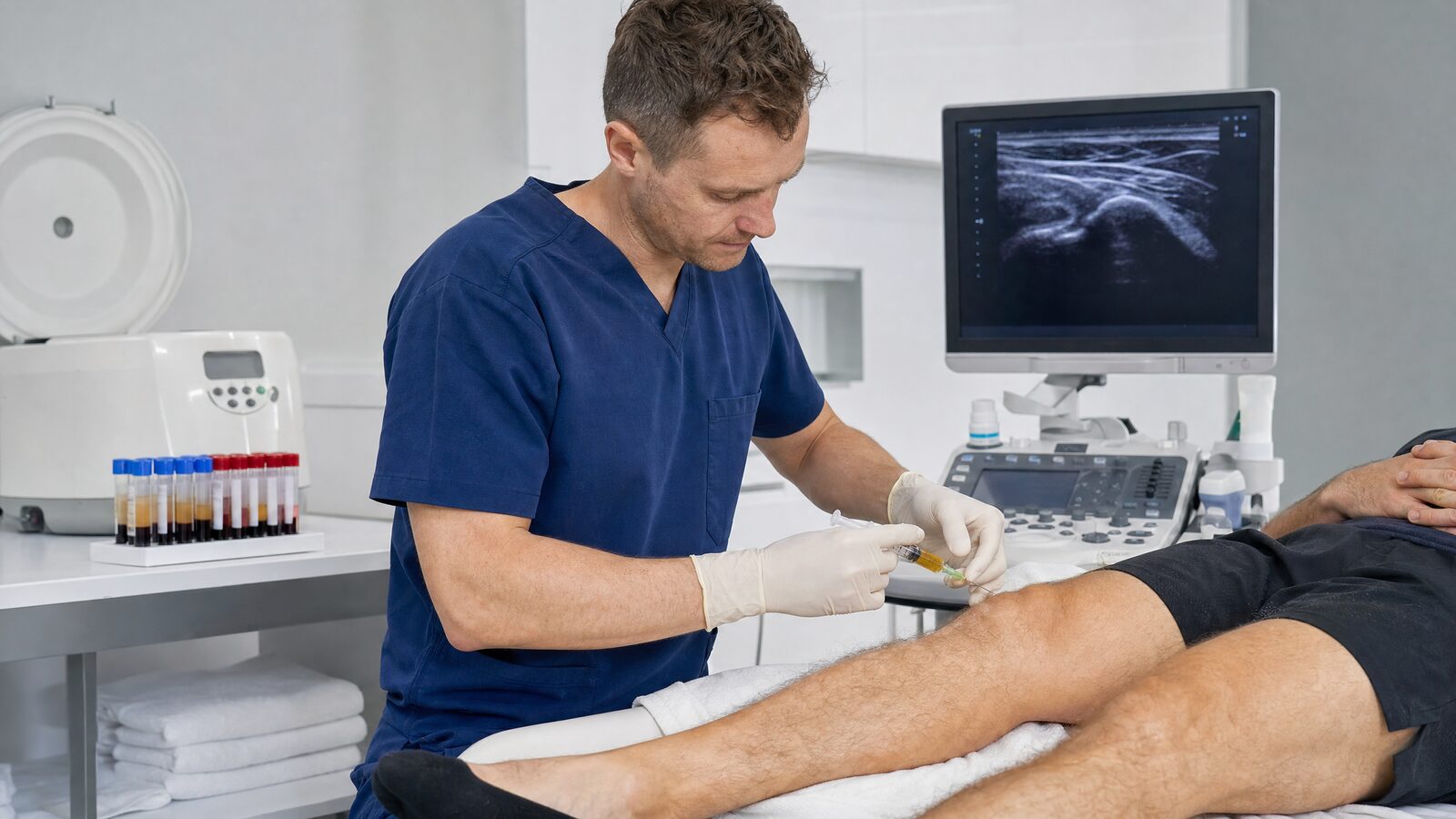
Cork Surgery, for example, offers PRP for knee osteoarthritis using a three-injection protocol with one-week intervals between sessions. The Orthopaedic Injection Clinic in Ranelagh, Dublin also provides PRP injections for joint conditions. These are representative of the kind of specialist-led services available in Irish cities, and patients considering PRP should look for clinics where the injections are performed by practitioners with specific training in musculoskeletal medicine and, ideally, where ultrasound guidance is used to ensure accurate placement in the joint.
When evaluating a clinic, it is worth asking about the PRP preparation system used, since this study's findings suggest that platelet concentration and leukocyte content matter for outcomes. Not every clinic will use the same system, and a higher-quality preparation may justify a higher price. Ask whether the PRP is leukocyte-reduced, what platelet concentration the system achieves, and whether calcium chloride activation is used. These are legitimate clinical questions informed by the evidence, and a good practitioner will be happy to discuss them. You should also expect a thorough assessment of your knee, including imaging, before PRP is recommended, and a frank discussion about whether your age and disease stage make you a good candidate based on the available evidence.
The bottom line: what this means if you are considering PRP
This meta-analysis provides the most rigorous evidence to date that PRP injections produce real improvements in knee pain and function beyond the placebo effect, sustained to at least twelve months. That is a genuinely useful finding for the millions of people worldwide living with knee osteoarthritis and looking for non-surgical options. The fact that a second independent 2026 meta-analysis reached similar conclusions adds weight to the positive signal.
At the same time, the very low certainty rating is an important and honest caveat. It means the field has not yet produced the kind of clean, consistent evidence that would allow us to say with confidence exactly how much PRP helps, which specific preparation is best or which patients will benefit most. The associations with younger age, leukocyte-reduced preparations, higher platelet concentrations and calcium chloride activation are all biologically plausible and statistically supported, but none has been definitively proven as an independent driver of outcomes. More standardised, head-to-head trials are needed to answer these questions, and the authors of this study are clear about that.
For patients in Ireland considering PRP for knee osteoarthritis, the practical takeaway is cautiously optimistic. The evidence supports PRP as a treatment that probably helps, particularly if you are younger, have mild to moderate disease and can access a clinic using a high-quality, leukocyte-reduced preparation. It is not a certain solution, and anyone marketing it as one is overstepping the evidence. But as one option among several for managing a condition that has no perfect treatment, PRP has earned a place in the conversation, backed by a growing body of Level I evidence. Discuss it with your orthopaedic specialist or sports medicine practitioner, ask about the specific preparation they use, and go in with realistic expectations about both the promise and the uncertainty.